When Literacy Changes, Power Changes
There was a time when literacy meant the ability to read sacred texts, legal documents, letters, and books. Those who could read had access to knowledge. Those who could not were dependent on others to interpret the world for them. Literacy was not only a personal skill; it was a form of power. It decided who could learn, who could trade, who could govern, who could argue, who could remember, and who could participate in society.
Then came another kind of literacy: industrial literacy. People had to learn clocks, factories, procedures, machines, forms, transport systems, and bureaucratic routines. Later came computer literacy. A person who could use a word processor, spreadsheet, email, and presentation software had a visible advantage in the office. In the 1990s and early 2000s, many experienced professionals found themselves embarrassed by young employees who were not necessarily wiser, but were faster with computers. A senior officer might have known the subject deeply, but the junior employee who could format the report, prepare the spreadsheet, search the web, and send the email suddenly became indispensable.
Then came internet literacy. The question was no longer simply, “Do you know the answer?” It became, “Can you find the answer?” Search engines changed the value of memory. Social media changed the value of visibility. Smartphones changed the value of responsiveness. Digital platforms changed business models, education, politics, entertainment, and relationships. A person who could not use digital tools was not necessarily unintelligent. But he or she was increasingly disadvantaged in a world whose basic operating system had changed.
Now we are entering the next stage: intelligence literacy.
This is the ability to work with systems that can generate language, ideas, images, code, summaries, plans, recommendations, and arguments. It is the ability to direct an intelligent tool, question it, refine it, verify it, improve it, and integrate it into meaningful human work. It is not the same as coding. It is not the same as data science. It is not limited to engineers. It belongs to teachers, doctors, lawyers, students, managers, artists, writers, entrepreneurs, public servants, coaches, journalists, researchers, and parents. It is becoming a basic skill for educated life.
The person who cannot use AI will not become useless. That is too harsh and too simplistic. But such a person may become slower in learning, weaker in preparation, narrower in perspective, less efficient in communication, and less able to compete with someone who uses AI well. The issue is not whether AI has intelligence exactly like a human being. The issue is whether it changes the productivity of human beings who know how to use it. And the early evidence suggests that it does.
The Strange Lesson of the Productivity Studies
When researchers began studying generative AI in real workplaces, one of the most interesting findings was not simply that AI improved productivity. It was that the benefits were uneven. In a widely discussed study of customer support agents, access to generative AI assistance improved productivity substantially, especially for less experienced workers. The AI did not replace the agent. It guided the agent. It helped with responses, language, problem-solving, and consistency. The junior worker suddenly had access to patterns of expertise that would normally take months or years to absorb.
This is a profound change. Traditionally, experience was built slowly. A young employee learned by watching seniors, making mistakes, receiving feedback, and gradually understanding what worked. AI compresses part of that learning curve. It does not give wisdom automatically, but it can make useful patterns available earlier. A beginner can ask better questions. A non-expert can enter a complex subject faster. A person with average writing ability can produce a clearer draft. A nervous speaker can rehearse difficult situations. A new manager can prepare for conversations that once required years of exposure.
But another study involving consultants revealed a more subtle lesson. AI helped professionals perform better on tasks that were within the AI’s capability. They completed more tasks, worked faster, and produced higher-quality output. But on tasks outside the AI’s reliable range, overreliance could hurt performance. In other words, AI was not a simple magic wand. It was more like a powerful vehicle on an uneven road. On some roads it made people dramatically faster. On other roads, if they trusted it too much, they could drive into trouble.
This is one of the most important ideas in this book: AI literacy is not blind usage. It is skilled collaboration.
The beginner says, “AI gave me the answer.”
The skilled user says, “AI gave me a possible answer. Now I must examine it.”
The beginner says, “Write this for me.”
The skilled user says, “Help me think through this, give me alternatives, show me weaknesses, and improve the draft.”
The beginner says, “This looks good.”
The skilled user says, “Is this true, relevant, ethical, original, and appropriate?”
The beginner treats AI like an oracle.
The skilled user treats AI like a brilliant but imperfect assistant.
That difference may decide careers.
The Calculator Did Not Kill Mathematics
Whenever a new technology enters learning or work, people fear that it will weaken human ability. The calculator was once seen as a threat to mathematical learning. If students could press buttons, would they forget arithmetic? The spell-checker was seen as a threat to spelling. If software corrected words, would people stop learning language? Search engines were seen as a threat to memory. If information was always available, would people stop remembering anything? GPS was seen as a threat to navigation. If maps spoke to us, would we forget how to find our way?
These fears were not entirely wrong. Tools do change habits. A person who always uses GPS may become weaker at mental mapping. A person who depends entirely on spell-check may become careless with language. A person who searches everything may develop shallow memory. Technology can weaken us when we use it passively.
But tools also elevate us when we use them intelligently. The calculator did not kill mathematics. It shifted human attention from routine calculation to higher-order problem-solving. Spreadsheets did not eliminate financial thinking. They allowed more people to model scenarios, compare numbers, and test assumptions. Search engines did not end learning. They changed the first step of learning. The problem was never the tool itself. The problem was whether the tool replaced thinking or supported thinking.
AI presents the same challenge at a much higher level.
Used lazily, AI can make people intellectually soft. It can encourage copy-paste thinking, generic writing, shallow research, and false confidence. It can produce a world filled with polished emptiness: emails that sound professional but say little, reports that look impressive but lack insight, posts that feel inspirational but are made of recycled phrases. Used badly, AI can make mediocrity faster.
Used wisely, however, AI can become a force for clarity. It can help people learn faster, think more broadly, communicate better, test ideas, overcome blank-page anxiety, and build confidence. It can bring expert-like assistance to people who never had access to elite mentors. It can help a student understand quantum physics, a small business owner write a marketing plan, a doctor explain a diagnosis in simple language, a teacher design lesson plans, a young officer prepare a policy note, a writer organize a book, and a professional rehearse a difficult conversation.
The key question is not: Should we use AI?
The key question is: What kind of users will we become?
Prompting Is the New Writing
Writing changed civilization because it allowed human beings to store thought outside the body. A spoken word disappeared into the air. A written word could travel across time. It could become law, poetry, scripture, contract, constitution, love letter, scientific theory, political manifesto, or business proposal. Writing extended the human mind.
Prompting is not the same as writing, but it has a similar civilizational importance in the AI age. A prompt is a way of directing machine intelligence. It is how human intention enters an AI system. A vague prompt produces vague output. A lazy prompt produces lazy output. A confused prompt produces confused output. A precise prompt can produce analysis, structure, drafts, questions, comparisons, plans, and creative possibilities.
But prompting is not typing. It is thinking before typing.
When a person writes a prompt, that person must clarify the role, task, context, audience, tone, standard, and output. This is why prompting is secretly a thinking discipline. You cannot prompt well if you do not know what you want. You cannot guide AI well if your own goal is foggy. You cannot get a strategic answer from a poorly framed question.
Suppose a young manager types: “Write about leadership.” The AI will produce something ordinary. It may say leadership is about vision, communication, empathy, decision-making, and teamwork. Correct, but forgettable. Now suppose the same manager writes: “Act as an experienced leadership coach. Write a 900-word article for first-time managers on why listening is more powerful than giving instructions. Use a warm tone, include one workplace story, three practical tools, and a strong closing paragraph.” The output changes because the thinking behind the prompt has changed.
This is why prompting is the new writing. Not because everyone will become a prompt engineer, but because everyone will need to learn how to express intention clearly to intelligent systems. The future professional will not only write emails, reports, and presentations. The future professional will write instructions to intelligence.
Thinking Is the New Filtering
The internet gave us access to information. AI gives us access to generated answers. But abundance creates a new problem. When information was scarce, the challenge was finding it. When answers are abundant, the challenge is filtering them.
AI can generate ten options in seconds. That sounds wonderful until you realize that now you must choose. It can create five versions of an email. Which one is appropriate? It can suggest a strategy. Is it realistic? It can summarize a legal issue. Is it accurate? It can write a medical explanation. Is it safe? It can produce a business plan. Does it understand the market? It can generate a motivational speech. Does it have a soul?
The more AI produces, the more human judgment matters.
This is the paradox of the AI age. Many people imagine that thinking will become less important because machines can think for us. In reality, thinking becomes more important because machines can produce so much that looks like thinking. The user must separate signal from noise, truth from fluency, insight from cliché, originality from imitation, and usefulness from impressiveness.
A beautifully written wrong answer is still wrong. A confident answer without evidence is still dangerous. A persuasive argument with hidden bias is still flawed. A creative idea that violates ethics is still unacceptable. A strategy that ignores local context is still weak. A summary that omits the most important risk is still misleading.
Therefore, thinking is the new filtering. The AI-literate professional asks: Is this true? Is this relevant? What is missing? What assumptions are hidden? What evidence supports this? What could go wrong? Who may be harmed? How would an expert challenge this? How does this apply to my actual situation?
AI may generate the first draft. The human must provide the final responsibility.
Creating Is the New Career Advantage
For most of industrial history, careers rewarded execution. Do the assigned work. Follow the process. Complete the file. Produce the report. Attend the meeting. Send the update. Meet the deadline. Execution still matters, but execution alone is no longer enough. AI can increasingly assist execution. It can draft, summarize, analyze, format, translate, and generate. As these abilities become common, the premium shifts toward creation.
Creation does not only mean writing a novel, painting a picture, or composing music. Creation means bringing something useful into the world that did not exist before. A new framework. A better process. A clearer explanation. A stronger proposal. A fresh product idea. A sharper presentation. A more humane policy. A compelling message. A new learning path. A better client solution. A meaningful brand. A practical tool. A valuable insight.
AI can support creation, but it cannot replace the human source of meaning. It can combine existing patterns, but it does not have your childhood, your struggles, your failures, your relationships, your local knowledge, your moral instincts, your professional scars, or your lived wisdom. It can imitate tone, but it has not lived a life. It can generate a story, but it has not paid the price of experience. It can produce options, but it cannot care about your purpose.
The future belongs to people who use AI to become more creative, not more generic.
This is especially important for young professionals. In the old world, a young person often had to wait many years before contributing original value. First observe. Then assist. Then draft. Then manage small tasks. Then slowly earn trust. AI changes this sequence. A young professional with curiosity and discipline can now learn faster, prepare better, ask sharper questions, and produce more polished work earlier. This does not eliminate the need for experience, but it accelerates the path toward contribution.
The creator in the AI age is not someone who avoids technology. Nor is it someone who blindly depends on technology. The creator is someone who uses AI as a collaborator while retaining human taste, courage, and judgment.
The Danger of Becoming Average Faster
There is, however, a serious danger. AI can make people better, but it can also make them similar.
If millions of people use the same tools, ask similar prompts, accept similar phrases, and publish similar outputs, the world will become flooded with average content that sounds smooth but feels lifeless. We already see signs of this: emails that begin with the same polite rhythm, articles that use the same structure, motivational posts that sound profound but say nothing new, resumes filled with polished emptiness, speeches that have perfect grammar but no pulse.
The danger is not that AI will make us stupid. The danger is that AI will make us standard.
This is why the human element becomes more important, not less. The best AI users will not be those who ask AI to replace their voice. They will be those who use AI to refine their voice. They will bring their own stories, convictions, examples, humor, cultural context, field experience, and moral imagination. They will ask AI for possibilities, but they will not let AI decide their personality.
In the AI age, your lived experience becomes a competitive advantage. Your taste becomes a competitive advantage. Your questions become a competitive advantage. Your ability to say, “This is correct but not beautiful,” or “This is efficient but not humane,” or “This is impressive but not wise,” becomes a competitive advantage.
The machine can produce language. You must produce meaning.
This Book Is Not About Tools; It Is About a New Way of Working
Many books about AI become outdated quickly because they focus too much on tools. Today’s most popular platform may change tomorrow. Features will evolve. Interfaces will improve. New models will appear. Some companies will rise, others will disappear. The names may change: ChatGPT, Claude, Gemini, Copilot, Perplexity, and many more. But the deeper literacy will remain.
This book is not mainly about which button to click. It is about how to think, work, learn, communicate, and create in an age where intelligence is becoming available on demand.
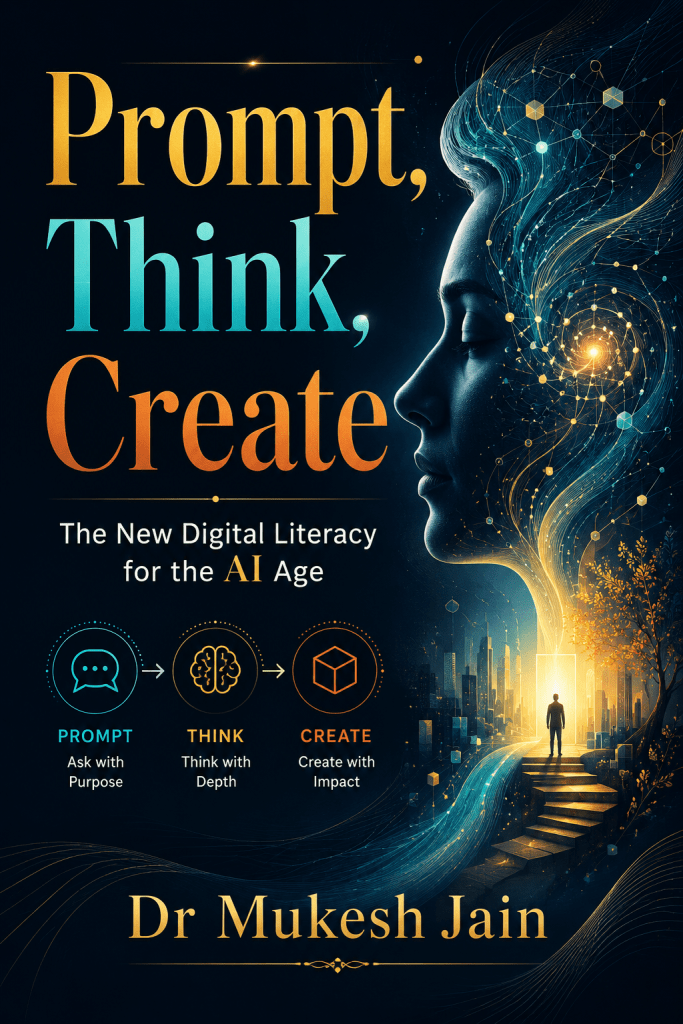
The book is built around three words: Prompt, Think, Create.
- Prompt means learning how to communicate with AI clearly. It means giving better instructions, better context, better goals, and better standards. It means treating AI not as a search box, but as a collaborator that improves when guided well.
- Think means learning how to evaluate what AI gives you. It means questioning, verifying, filtering, comparing, challenging, and applying judgment. It means never mistaking fluency for truth or confidence for wisdom.
- Create means using AI to produce better work and build a stronger career. It means writing better, learning faster, solving problems, generating ideas, making decisions, building workflows, and developing a distinctive human edge.
Together, these three abilities form the new digital literacy.