
If you really want to understand how someone is doing in life, try asking them a question that feels almost too ordinary to matter:
“How many meals did you share with someone you know in the last seven days?”
Not their income.
Not their fitness tracker score.
Not how many books they read or how early they wake up.
Just meals.
Because beneath all the noise of modern life—deadlines, screens, traffic, constant notifications—there is a quiet truth we keep forgetting:
Human beings are wired for connection. And one of the oldest, simplest ways we connect is by eating together.
Why connection is not “nice to have,” but necessary
For decades, scientists have been studying what actually makes life healthier and happier. The answer, again and again, points in the same direction.
People who are more socially connected tend to be happier, calmer, and more satisfied with life. They experience less depression. They cope better with stress. Their bodies recover faster from illness. Their lives feel steadier.
And this doesn’t stop at personal life.
At work, people with stronger social connections are often more creative, more cooperative, and more trusted. They are more likely to grow in their careers, earn better, and stay engaged. Over time, they even tend to live longer.
On the other hand, loneliness is not just an emotion—it is a risk factor. Social isolation has been linked to higher disease rates, shorter life expectancy, lower wellbeing, and even greater anger and polarization in society.
One large scientific analysis put it bluntly:
chronic loneliness can be as damaging to health as smoking about 15 cigarettes a day.
That’s not a metaphor. That’s biology. No wonder Chris Peterson, one of the founders of positive psychology, summed up decades of research in just three words:
“Other people matter.”
Meals are not just food. They are connection in disguise. Here’s where things get surprisingly interesting.
We often try to measure social connection by asking people how close they feel to others. But those answers depend on mood, culture, personality, and expectations. What feels “close” to one person might feel distant to another.
Shared meals are different.
You either ate with someone—or you didn’t.
They are concrete. Observable. Easy to remember.

That’s why researchers are now treating meal-sharing as a powerful window into social connection—and, by extension, wellbeing.
And this idea isn’t new. Language itself carries the clue.
In French, copain (friend) comes from the idea of “with bread.”
In Italian, compagno (mate) literally means “with bread.”
Even ancient Chinese words for companion trace back to sharing food around a fire.
Across cultures and centuries, eating together has always meant more than eating.
It meant trust. Safety. Belonging.
The global data that made people sit up and notice
Until recently, shared meals were rarely studied at a global scale. That changed when the Gallup World Poll added questions on social eating in 2022 and again in 2023. More than 150,000 people across 142 countries were asked just two simple questions:
- On how many days in the last week did you eat lunch with someone you know?
- On how many days did you eat dinner with someone you know?
What emerged was a fascinating picture of how connected—or disconnected—different societies really are. Some parts of the world eat together far more than others The differences were striking.
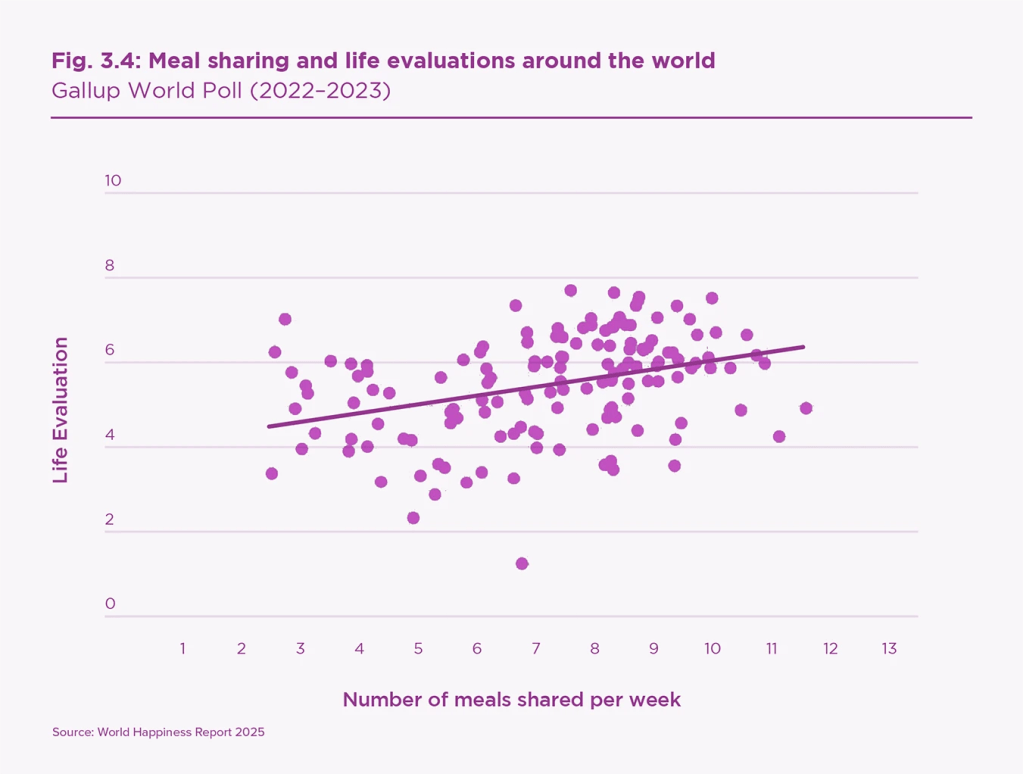
In Latin America and the Caribbean, people share around nine meals a week on average. Food there is deeply social. Meals stretch into conversations. Tables are gathering places.
In South Asia, the average is less than four shared meals a week.
That gap is enormous. It reflects very different social rhythms of everyday life.
At the country level, the contrast is even sharper:
Senegal sits near the top, with almost 12 shared meals a week
Gambia, Malaysia, and Paraguay are also very high
Iceland is one of the few Western countries near the top
Canada and the U.S. sit somewhere in the middle
India ranks very low, around four shared meals a week
At the bottom are countries like Bangladesh and Estonia, where people report sharing fewer than three meals a week
Researchers note that culture may influence how people interpret the question. In some places, people may not count family members the same way. Even so, the overall pattern is too strong to ignore.
This is not about money
A tempting explanation is income: maybe richer societies eat together more.

But the data doesn’t support that. Some of the highest levels of meal-sharing are found in lower-income regions. Income explains only a small part of the global variation. Which means this is not mainly about wealth.
It’s about habits. Culture. Community design. And how we organize daily life.
Younger people share more meals—but everyone benefits
Across most regions, younger people report sharing more meals than older adults. That matters, because it may help explain why loneliness and mental health challenges change across the lifespan.
One reassuring finding: men and women share meals at almost identical rates worldwide. This isn’t a “men’s issue” or a “women’s issue.” It’s a human issue.
The heart of the matter: shared meals predict wellbeing
Here’s the most important finding.
Across countries, regions, ages, and genders, people who share more meals tend to feel better about their lives.
Researchers looked at three things:
- overall life satisfaction
- positive emotions like joy and enjoyment
- negative emotions like stress and sadness
The pattern held everywhere.
At the national level, countries where people eat together more report higher average wellbeing. At the individual level, people who eat with others report better emotional health. And the most powerful difference appears very early. People who eat all meals alone report much lower wellbeing than those who share even one meal in a week.
Just one.
That small shift matters. Even more interesting, shared meals are especially powerful for daily mood—laughter, enjoyment, and lightness—sometimes more than for long-term life satisfaction.
In simple terms:
Eating together makes everyday life feel better.
People even report enjoying their food more when they share it.
Does eating together cause happiness?
Honest science avoids exaggeration.
Do shared meals make people happier?
Or do happier people simply eat together more?
The most likely answer is: both.
Eating together builds connection, which boosts wellbeing.
Feeling better makes people more open to connection.
Researchers controlled for income, employment, education, household size, and food affordability—and the relationship still remained strong.
Causality may be complex, but the signal is clear.
Why this matters beyond the dining table
This isn’t just about individual happiness.
When people feel connected, societies function better.
Trust increases.
Civic engagement rises.
People give more, help more, and care beyond their immediate circle.
That means meal-sharing isn’t a lifestyle tip.
It’s social infrastructure.
Workplaces can protect shared lunch time—no meetings, no agenda
Schools can treat family meals as part of wellbeing, not just nutrition
Cities can design public eating spaces that invite interaction
Families can aim for rhythm, not perfection—two or three shared meals a week is enough
The simplest habit with the biggest return
If you take nothing else from this, take this:
Start with one shared meal this week.
No fancy planning.
No perfect menu.
No Instagram-worthy table.
Just one meal, shared without distraction.
Because the table is more than furniture.
It’s where bodies relax.
It’s where loneliness loosens.
It’s where we remember that we are not meant to do life alone.
The world is obsessed with hacks, shortcuts, and optimization. But one of the deepest upgrades to human wellbeing is older than civilization itself:
Eat with people. Often.
- Dr Mukesh Jain
- Author, Dr Mukesh Jain, is an alumnus of Kennedy School of Government, Harvard University, Indian Institute of Management Ahmedabad, and Indian Institute of Technology Delhi. His book ‘A happier You’ has received book of the year award in the year 2023.



 School Of Happiness by Mukesh Jain
One response to “The Table Effect: Why Eating Together May Be the Smallest Change That Makes the Biggest Difference to Our Happiness levels”
Loved reading every line of it ! It’s amazing how something as simple as sharing meals can have such a profound impact on our happiness and wellbeing. It makes you rethink your priorities and cherish those shared meals!
Regards
LikeLike