
Ever walked into a room and felt like all eyes were on you? Maybe you spilled coffee on your shirt and thought, Great, now everyone is laughing at me. Or you tripped in public and were convinced that people were still whispering about it hours later, picturing them replaying your clumsy moment in their heads as if it were a scene from a viral fail video. Maybe you’ve been in a meeting, stumbled over a few words, and instantly felt a wave of panic, assuming that your colleagues were secretly judging your intelligence. Or you left the house wearing something a little different from your usual style and spent the entire day feeling hyper-aware of every glance in your direction, convinced that people were silently critiquing your outfit.
Reality check: They weren’t.
Welcome to the Spotlight Effect—a psychological illusion that tricks us into believing that others are paying far more attention to us than they actually are. Whether it’s an embarrassing moment, an awkward conversation, a fashion choice that feels too bold, or even just a bad hair day, we assume people are noticing, analyzing, and forming opinions about us when, in reality, they are too caught up in their own thoughts, worries, and self-perceptions to care. Everyone else is too busy living their own movie, where they are the main character, to focus on the details of yours.

We all experience this bias at some point, and while it might seem like a minor quirk of human psychology, it actually has far-reaching consequences. It doesn’t just create fleeting moments of embarrassment—it shapes how we think, act, and interact with the world in profound ways. The Spotlight Effect fuels social anxiety, making us more hesitant to engage in conversations or express our opinions for fear of being judged. It stops us from taking risks, keeping us in our comfort zones even when an opportunity for growth is right in front of us. It causes us to pass up chances, whether it’s a chance to speak up in a meeting, ask someone out, try a new hobby, or pursue an unconventional career path, all because we falsely believe that others are watching and scrutinizing our every move.
And yet, the irony is that while we’re busy overanalyzing our own mistakes, choices, and perceived shortcomings, everyone else is doing the exact same thing about themselves. That moment you tripped? It was barely a passing blip in someone else’s day. The time you wore mismatched socks and thought it was the most noticeable thing about you? Most people didn’t even glance at your feet. That slightly awkward joke you made in a group conversation? It’s already been forgotten, while the others are too busy rehashing their own awkward moments in their minds.
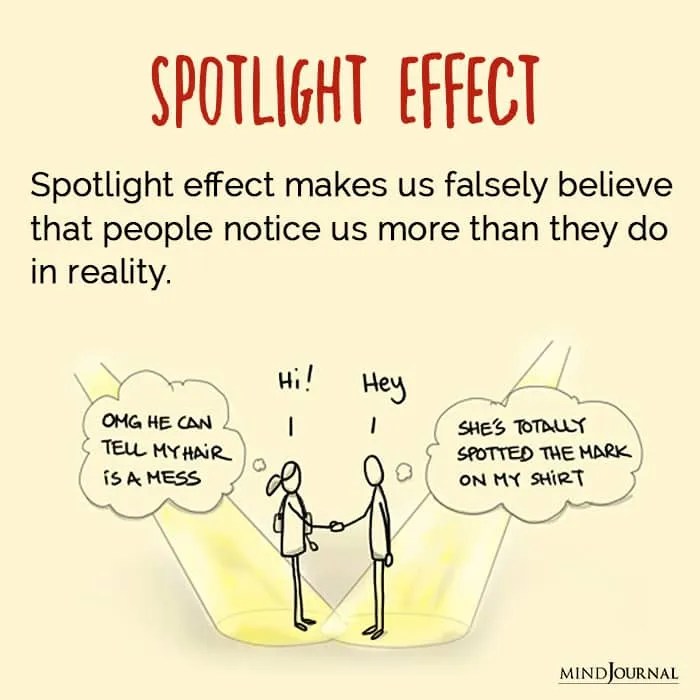
The good news? Once you understand why your brain does this—and how to flip the script—you can break free from the cycle of self-consciousness and start living with confidence. You can walk into a room without feeling like the world is watching, you can take social risks without fear, and you can finally start seeing yourself the way the world actually sees you—as just another person going about their day, far less scrutinized than your anxious brain might have you believe.
What is the Spotlight Effect?
The Spotlight Effect is a powerful cognitive bias that leads people to believe they are far more noticeable than they really are. It’s the feeling that everyone around you is watching, analyzing, and remembering every little thing you do, when in reality, most people are far too absorbed in their own lives to give you more than a fleeting thought.
At its core, the Spotlight Effect causes us to:
- Overestimate how much attention others pay to us—we assume that our actions, words, and even our physical appearance are constantly being scrutinized.
- Believe that both our mistakes and our achievements leave a lasting impression—we assume that people are carefully cataloging our errors and successes in their mental notebooks, when in reality, they’re not.
- Feel like we are always “on stage” in social situations—as if we’re under a metaphorical spotlight, being judged and evaluated by an audience that, in truth, barely notices.
This bias works in both positive and negative ways, distorting our perception of reality in subtle but significant ways.
For example, say you deliver an outstanding presentation at work or school. You walk away thinking that everyone must still be talking about how impressive you were. You imagine your colleagues whispering to each other, “Wow, that was amazing—what a natural speaker!” But in reality? Most of them moved on within minutes. Sure, they might have appreciated it at the moment, but their minds quickly shifted back to their own tasks, deadlines, and personal worries.
Now flip the scenario: You stumble over a few words, lose your train of thought, or mispronounce something. Instantly, your mind goes into overdrive. You feel like the entire room noticed, that everyone is secretly judging your intelligence, and that your reputation has taken a hit. You assume that later, people will whisper, “Did you hear how they messed up?” But once again, reality proves otherwise. Most of your audience didn’t even notice, and if they did, they quickly forgot about it—because, like you, they are caught up in their own thoughts and concerns.
Psychologist Thomas Gilovich, who first coined the term “Spotlight Effect,” summed it up perfectly:
“We are all the center of our own universes, but that doesn’t mean we’re the center of anyone else’s.”
Think about that for a moment. You are the main character in your own story—but to everyone else, you are just a supporting role, a brief extra in the movie of their life. They are too busy worrying about how they come across to spend much time thinking about you. This realization can be incredibly liberating. It means that you are freer than you think—to make mistakes, to take risks, to step outside of your comfort zone—because no one is paying nearly as much attention as you imagine.
The Study That Exposed the Illusion
To put the Spotlight Effect to the test, researchers Thomas Gilovich and Kenneth Savitsky devised an experiment that was both simple and hilarious—but its results revealed a profound truth about human perception.
The researchers asked participants to wear an embarrassing t-shirt featuring the face of Barry Manilow, a musician known for his dramatic ballads but not exactly a pop culture icon among college students at the time. The idea was to make the participants feel self-conscious—after all, being forced to wear something that you believe makes you stand out in an awkward way is a perfect setup to test how much attention others really pay to you.
Each participant was then instructed to walk into a room filled with strangers and simply exist in that space for a brief period. But before they did, the researchers asked them to estimate how many people in the room would notice and later remember their t-shirt.
- The participants assumed that nearly 50% of people would notice and remember their humiliating fashion statement. They were convinced that their embarrassing shirt would be the center of attention, the unmissable focal point of the entire room.
- The reality? Less than 25% of the people even noticed the t-shirt, let alone remembered it.
This wasn’t because the other participants were uninterested or pretending not to notice—they were simply too busy thinking about themselves.
This experiment proved a striking psychological truth: we wildly overestimate how much people notice our flaws, mistakes, and even our achievements. What seems like a glaring issue to us is often nothing more than background noise to everyone else.
The Spotlight Effect in Real Life (And How It Holds You Back)
Let’s break down how this illusion keeps us stuck—and how to move past it.
1. Fear of Judgment Stops You from Taking Action
How often have you held back just because of what others might think? Maybe you stayed silent in a meeting, hesitated before sharing a post, or avoided trying something new—convinced that any mistake would be noticed and remembered forever. But here’s the truth: most people won’t even notice. Everyone is caught up in their own lives, insecurities, and worries. The few who do notice will forget within minutes. And the tiny fraction who remember? They’re not thinking about it nearly as much as you are. We think others are analyzing our every move, but guess what? They’re doing the same thing—about themselves. That means the pressure you feel? It’s an illusion. Once you realize this, you can stop holding back and start living.
2. The Regret of Missed Opportunities
Now think about all the things you didn’t do because you were afraid of judgment. You didn’t pursue a dream career because it felt risky. You didn’t ask someone out because you feared rejection. You didn’t dance at that party—even though you really wanted to.

Now ask yourself: Who actually would have cared? We convince ourselves that the world is keeping score of our every move, but it’s not. Most people don’t remember, don’t care, and aren’t judging you. Yet this illusion stops us from taking risks, leading to a lifetime of unnecessary regrets. But here’s the good news: It’s not too late to change. Once you see the Spotlight Effect for what it is—a trick your brain plays on you—you can start making decisions based on what you actually want, instead of what you think others expect.
3. Social Anxiety and Mental Health
For those with social anxiety, the Spotlight Effect becomes a self-reinforcing cycle: You believe people are judging you—at work, in social settings, even while walking down the street. You overanalyze your every move, making you even more self-conscious. This distraction makes social interactions harder, fueling even more anxiety. You assume others noticed your awkwardness, reinforcing your fear.
The worst part? Most of this fear is self-created. Research shows that socially anxious individuals experience the Spotlight Effect more intensely, meaning they feel judged—even when they’re not. The key to breaking this cycle? Reframing your perspective.
Instead of thinking: Everyone is watching me. Try: Everyone is too busy thinking about themselves. Instead of: They’ll remember this forever. Try: Even I won’t remember this in a week.
Most of the time, you’re giving too much power to an imaginary audience. The moment you realize this, you free yourself from unnecessary anxiety. So the next time you hesitate—before raising your hand, stepping out of your comfort zone, or going after something you want—remind yourself of this simple truth:
Nobody is watching you as closely as you think.
And once you step out of that imaginary spotlight, you’ll discover something incredible: the world is far more open, forgiving, and liberating than you ever imagined.
____________________________________________
About the author

Dr Mukesh Jain is a Gold Medallist engineer in Electronics and Telecommunication Engineering from MANIT Bhopal. He obtained his MBA from the Indian Institute of Management Ahmedabad. He obtained his Master of Public Administration from the Kennedy School of Government, Harvard University along with Edward Mason Fellowship. He had the unique distinction of receiving three distinguished awards at Harvard University: The Mason Fellow award and The Lucius N. Littauer Fellow award for exemplary academic achievement, public service & potential for future leadership. He was also awarded The Raymond & Josephine Vernon award for academic distinction & significant contribution to Mason Fellowship Program. Mukesh Jain received his PhD in Strategic Management from IIT Delhi.
Mukesh Jain joined the Indian Police Service in 1989, Madhya Pradesh cadre. As an IPS officer, he held many challenging assignments including the Superintendent of Police, Raisen and Mandsaur Districts, and Inspector General of Police, Criminal Investigation Department and Additional DGP Cybercrime, Transport Commissioner Madhya Pradesh and Special DG Police.
Dr. Mukesh Jain has authored many books on Public Policy and Positive Psychology. His book, ‘Excellence in Government, is a recommended reading for many public policy courses. His book- “A Happier You: Strategies to achieve peak joy in work and life using science of Happiness”, received book of the year award in 2022. After this, two more books, first, A ‘Masterclass in the Science of Happiness’ and the other, ‘Seeds of Happiness’, have also been received very well. His book, ‘Policing in the Age of Artificial Intelligence and Metaverse’ has received an extraordinary reception from the police officers. He is a visiting faculty to many business schools and reputed training institutes. He is an expert trainer of “Lateral Thinking”, and “The Science of happiness” and has conducted more than 300 workshops on these subjects.



 School Of Happiness by Mukesh Jain
Leave a reply to SK Shahi Cancel reply