An Ancient Story That Explains Your Daily Struggles
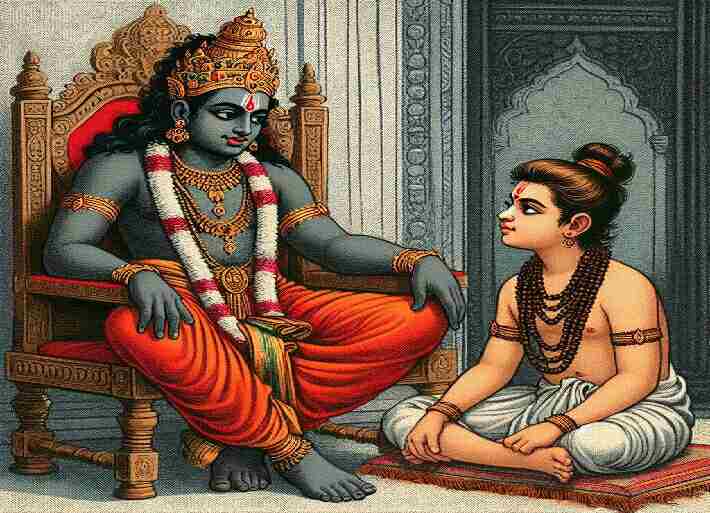
There is something deeply cinematic about the story of Nachiketa.
The story appears in the Katha Upanishad, one of the most psychologically profound texts ever written. The setting is simple. Nachiketa’s father, Vajashrava, is performing a grand sacrifice, giving away cows to earn spiritual merit. But the cows are old and useless — symbolic charity, not real sacrifice.
The boy notices.
Innocently, repeatedly, he asks his father: “To whom will you give me?”
Irritated, the father blurts out: “I give you to Yama, the god of Death.”
And the boy takes him seriously. He walks to the abode of Yama. Death is not home. Nachiketa waits for three days and nights — without food, without fear. When Yama returns, impressed by the boy’s patience and courage, he offers him three boons. The first two boons are practical — reconciliation with his father, and knowledge of sacred fire rituals.
But the third boon is extraordinary.
Nachiketa asks: “What happens after death? Does something remain, or does everything end?” Yama hesitates. He tries to distract the boy. He offers wealth, long life, beautiful companions, celestial pleasures — everything that human desire could imagine.
And here comes the central teaching.
Yama says:
“There are two paths before every human being: Shreya and Preya.”
The pleasant.
And the good.
The immediate.
And the meaningful.
The dialogue between Nachiketa and Yama, recorded in the Katha Upanishad, is one of the sharpest explorations of human decision-making ever written. And at its center lies a concept modern science is still decoding: the tension between what feels good now and what is good for us later. Yama tells the boy there are always two options before us:
- Preya — the pleasant.
- Shreya — the beneficial.
The immediate reward. The long-term right choice. That’s it. That’s the whole of behavioral science in two Sanskrit words.
Shreya vs Preya: The Ancient Psychology of Choice
In Sanskrit, Preya means what is pleasing — the path of instant gratification. Comfort. Sensory delight. Avoiding discomfort.
Shreya means what is ultimately beneficial — growth, discipline, alignment with deeper truth.
Yama explains that most people choose Preya because it is shiny and urgent. Only the wise choose Shreya, even if it is difficult.
This wasn’t written last year. This was articulated thousands of years ago. And yet modern psychology is still unpacking the same principle.
The Behavioral Trap of Preya
Behavioral economists call it present bias — we overvalue what is available now and undervalue future benefit.
You know exercise matters. But the sofa wins.
You know focused work builds mastery. But the phone vibrates.
You know integrity compounds. But short-term applause seduces.
Modern systems are engineered for Preya. Apps are designed for engagement loops. Advertising exploits reward circuitry. Consumer culture thrives on urgency. Neuroscience tells us that the human brain is wired for reward prediction. The neurotransmitter dopamine spikes not when we achieve something meaningful, but when we anticipate immediate pleasure.
- Scroll through social media — small dopamine spike.
- Eat sugary food — spike.
- Check notifications — spike.
This is Preya in neurochemical form.
Research in behavioral science, especially the famous Stanford Marshmallow Experiment, demonstrated that children who could delay gratification (choose two marshmallows later instead of one now) tended to have better life outcomes — academically, socially, financially.
That is Shreya.
Modern neuroscience explains this through the tension between two brain systems:
- The limbic system — fast, emotional, reward-seeking.
- The prefrontal cortex — slower, reflective, future-oriented.
When Yama speaks of Preya and Shreya, he is essentially describing this internal neurological conflict. The ancient rishis described it poetically. Neuroscientists describe it in MRI scans. The insight is identical.
The Psychology of Meaning vs Pleasure
Positive psychology distinguishes between hedonic happiness (pleasure-based) and eudaimonic happiness (meaning-based).
- Hedonic happiness feels good in the moment.
- Eudaimonic happiness feels right over a lifetime.
Research shows that people who orient their lives around meaning — contribution, growth, purpose — report deeper and more sustained well-being.
Pleasure fluctuates.
Meaning stabilizes.
Shreya corresponds to eudaimonia.
Preya corresponds to hedonia.
Modern research on neuroplasticity shows that repeated choices strengthen neural pathways. Each time we choose Preya — impulse, distraction, avoidance — we strengthen those circuits. Each time we choose Shreya — discipline, patience, long-term thinking — we strengthen executive control networks in the brain. The brain literally becomes what it repeatedly practices.
Where This Story Lives Today
You don’t have to travel to the house of Yama to face this choice.
It shows up quietly:
- When you choose learning over distraction.
- When you tell the truth instead of protecting image.
- When you invest in health instead of indulgence.
- When you choose long-term credibility over short-term gain.
Shreya is rarely dramatic. It is incremental. Preya is loud. It promises intensity. Shreya promises integrity.
The story is not about a boy and a mythological god. It is about the moment you sit alone with a choice.
- When your alarm rings at 5:30 AM.
- When you decide whether to speak truth or stay convenient.
- When you choose between short-term applause and long-term integrity.
In a world flooded with notifications, advertisements, quick success formulas, and instant validation loops, the Nachiketa story becomes startlingly contemporary. He represents long-game thinking. He represents the courage to ask ultimate questions when everyone else is bargaining for comfort. The brilliance of the Katha Upanishad is that it doesn’t demonize pleasure. It simply warns against confusing stimulation with fulfillment.
In today’s language, he chose long-game identity over short-game dopamine. And that might be the most relevant spiritual teaching for the digital age. Because the real question is not whether Death will offer you something dramatic.
The real question is smaller, quieter, daily:
Will you choose what feels good now?
Or what builds you for later?
Every morning, the door opens again.
And the choice waits.
Every day, the door of Yama opens for us in small ways.
The question remains the same as it was thousands of years ago:
Will you choose what is pleasant — or what is truly good?
 School Of Happiness by Mukesh Jain