
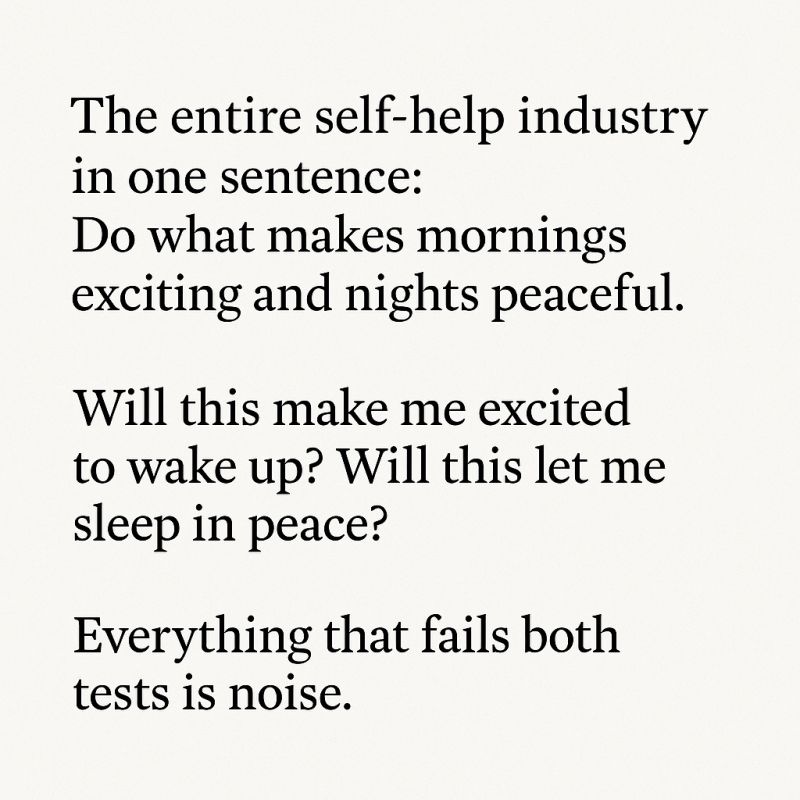
If you strip away the noise of the self-help industry — the thousands of books, podcasts, reels, workshops, and morning routines — what remains is surprisingly simple. A good life passes just two tests.
- Do you wake up excited?
- And do you go to bed in peace?
That’s it.
If your mornings feel alive and your nights feel calm, you are already living better than most people on the planet — including many who look successful from the outside. Everything else we chase — money, recognition, productivity, status, optimization — is only supposed to serve these two moments. When it doesn’t, it becomes noise. Modern life has complicated what was once instinctive. We’ve been taught to measure life by achievements, not feelings. But feelings don’t lie. Especially at the edges of the day. Mornings and nights quietly tell the truth about our lives.
The Morning Test: Do You Want to Wake Up to Your Life?

Mornings are honest. Before emails, before news, before expectations arrive, there is a brief moment when your mind is still uncluttered. In that moment, your body answers a simple question without words:
Am I looking forward to this day — or escaping it?
You cannot fake your first emotion in the morning.
If you wake up heavy, it doesn’t mean you are lazy or unmotivated. It usually means something in your life is misaligned with who you are becoming.
If you wake up curious, even slightly eager, even quietly hopeful — that’s not luck. That’s alignment. The mystic poet Rumi wrote centuries ago, “The breeze at dawn has secrets to tell you. Don’t go back to sleep.” This wasn’t just poetry. Modern psychology agrees. Research in neuroscience shows that early mornings are when the brain is least defensive. The ego is quieter. The mind hasn’t yet put on its armor. That’s why clarity often comes in the shower or at sunrise — not in meetings.
Arthur Brooks, who studies happiness at Harvard, explains that lasting well-being doesn’t come from avoiding effort. It comes from energizing effort. “The key to a good life,” he says, “is not pleasure or success, but meaning that gives you energy.” That energy shows up in the morning. Not as excitement to chase something — but excitement to contribute something.
- A thought.
- A skill.
- A conversation.
- A small act of usefulness.
You don’t need a perfect job to pass the morning test. You need one meaningful reason to get out of bed. That’s why some retirees wake up joyful, and some CEOs wake up exhausted.
The Night Test: Can You Rest With Yourself?

Nights ask a very different question. They don’t care about ambition. They don’t care about productivity. They care about peace.
At night, when distractions fall away, your mind quietly asks:
- Was I honest today?
- Did I live in line with what matters?
- Can I stop now — without guilt?
If sleep doesn’t come easily, it’s rarely because you did too little. More often, it’s because you spent your energy on things that didn’t deserve it.
Many high achievers fail the night test. They win the day — but lose sleep. Their minds replay conversations. Revisit mistakes. Rehearse tomorrow. This isn’t ambition. It’s unresolved living. Psychology shows that mental restlessness often comes from value conflict — when what we do all day doesn’t match what we believe matters.
Tal Ben-Shahar, whose happiness course became Harvard’s most popular, explains it simply: “Happiness is not about having everything. It’s about appreciating what you already have.” Gratitude is what allows the nervous system to power down. When your day contains meaning, your night allows surrender. Peace isn’t something you manufacture at bedtime. It’s something you earn through alignment during the day.

Why Mornings and Nights Are Linked
Mornings and nights are not separate. They are mirrors of each other.
When your mornings are meaningful, your nights grow peaceful.
When your nights are restful, your mornings grow alive.
But modern life disrupts this rhythm.
We chase excitement that destroys peace — endless hustle, stimulation, comparison. And we chase comfort that kills excitement — numbness, distraction, avoidance. We scroll late into the night and wonder why mornings feel dull. We overload our days and wonder why sleep feels shallow.
A good life honors both.
The Noise in Between
Most suffering doesn’t come from mornings or nights.
It comes from what fills the space between them.
- Meetings that don’t matter.
- Tasks that don’t align.
- Busyness that pretends to be importance.
Tim Ferriss, after interviewing hundreds of high performers, observed something uncomfortable:
“Being busy is a form of laziness — lazy thinking and indiscriminate action.”
We stay busy to avoid asking harder questions:
- Why am I doing this?
- Who am I trying to impress?
- What am I postponing?
Silence makes misalignment obvious. That’s why we avoid it.
But the simplest filter cuts through everything:
- Will this make my mornings more alive?
- Will this help me sleep in peace?
If the answer is no to both, it’s not worth your life energy.
What Research Says About This Simple Rule
Positive psychology repeatedly confirms what wisdom traditions have known for centuries. Shawn Achor found that people who start their day with gratitude and end it with reflection report significantly higher happiness — regardless of income or achievement. His conclusion is counterintuitive: “Happiness doesn’t come from success. Success grows from happiness.” In other words, peaceful nights and meaningful mornings don’t follow success. They create it.
A Simple Practice That Changes Everything
Try this for seven days.
- In the morning, before your phone:
What one thing today will make me feel alive?
Do that first.
- At night, before sleep:
What one thing today am I grateful for?
Hold it gently.
That’s it.
You’ll notice something shift. Not because the world changed — but because your awareness did.
A good life is actually very simple. It’s not about feeling excited every single day. And it’s not about being calm and detached all the time either. Life works best when there is balance.
- Work hard, but don’t lose your peace.
- Rest well, but don’t lose your spark.
That’s exactly what our Indian wisdom has always said. In the Bhagavad Gita, Krishna doesn’t tell Arjuna to run away from life, and he doesn’t tell him to become restless with ambition. He tells him to do his duty — but without letting stress eat him from inside.
In simple words: Do your best. Don’t torture your mind.
A good life has energy without tension — like walking briskly, not running till you collapse. And it has peace without boredom — like sitting quietly, but not feeling empty. If your mornings make you feel like getting out of bed — not because you’re scared or pressured, but because you’re okay with the day ahead —
and if your nights let you fall asleep without replaying worries again and again —
then you’re already doing life right. You don’t need a perfect job. You don’t need a bigger house. You don’t need to impress anyone. You just need to live in a way that feels right inside.
When your actions match your values, the mind relaxes on its own.
Everything else — the noise, the rush, the comparison, the endless chasing —
is just background disturbance between two quiet moments:
early morning
and late night.
Respect those two moments,
and life slowly starts respecting you back.
About the Author

Dr Mukesh Jain is a Gold Medallist engineer in Electronics and Telecommunication Engineering from MANIT Bhopal. He obtained his MBA from the prestigious management institute, the Indian Institute of Management Ahmedabad. He obtained his Master of Public Administration from the Kennedy School of Government, Harvard University along with Edward Mason Fellowship. He had the unique distinction of receiving three distinguished awards at Harvard University: The Mason Fellow award and The Lucius N. Littauer Fellow award for exemplary academic achievement, public service & potential for future leadership. He was also awarded The Raymond & Josephine Vernon award for academic distinction & significant contribution to Mason Fellowship Program. Mukesh Jain received his PhD in Strategic Management from IIT Delhi. His focus of research has been Capacity building of organizations using Positive psychology interventions, Growth mindset and Lateral Thinking etc.
Mukesh Jain joined the Indian Police Service in 1989, Madhya Pradesh cadre. As an IPS officer, he held many challenging assignments including the Superintendent of Police, Raisen and Mandsaur Districts, and Inspector General of Police, Criminal Investigation Department and Additional DGP Cybercrime, Transport Commissioner Madhya Pradesh and Special DG Police. He has also served as Joint Secretary in Ministry of Power and Ministry of Social Justice and Empowerment, Government of India. As Joint Secretary, Department of Persons with Disabilities, he conceptualized and implemented the ‘Accessible India Campaign’, launched by Hon’ble Prime Minister Shri Narendra Modi in December 2015. This campaign is aimed at creating accessibility in physical infrastructure, Transportation, and IT sectors for persons with disabilities and continues to be a flagship program of the Ministry of Social Justice and Empowerment, Government of India since 2015.
Dr. Mukesh Jain has authored many books on Public Policy and Positive Psychology. His book, ‘Excellence in Government, is a recommended reading for many public policy courses. A leading publisher published his book- “A Happier You: Strategies to achieve peak joy in work and life using science of Happiness”, which received book of the year award in 2022. His other books are : ‘Mindset for Success and Happiness’, ‘Seeds of Happiness’, and ‘What they don’t teach you at IITs and IIMs’.
He is a visiting faculty to many business schools and reputed training institutes. He is an expert trainer of “The Science of happiness”. He has conducted more than 250 workshops on the Science of Happiness at many prominent B-schools and administrative training institutes of India, including Indian School of Business Hyderabad/ Mohali, National Police Academy, IIFM, National Productivity Council etc.

 School Of Happiness by Mukesh Jain