I just finished reading Instant Positivity, a book by Kristen Butler and the best way I can describe the feeling is this: it felt like taking a slow, honest breath after holding it in for a long time.
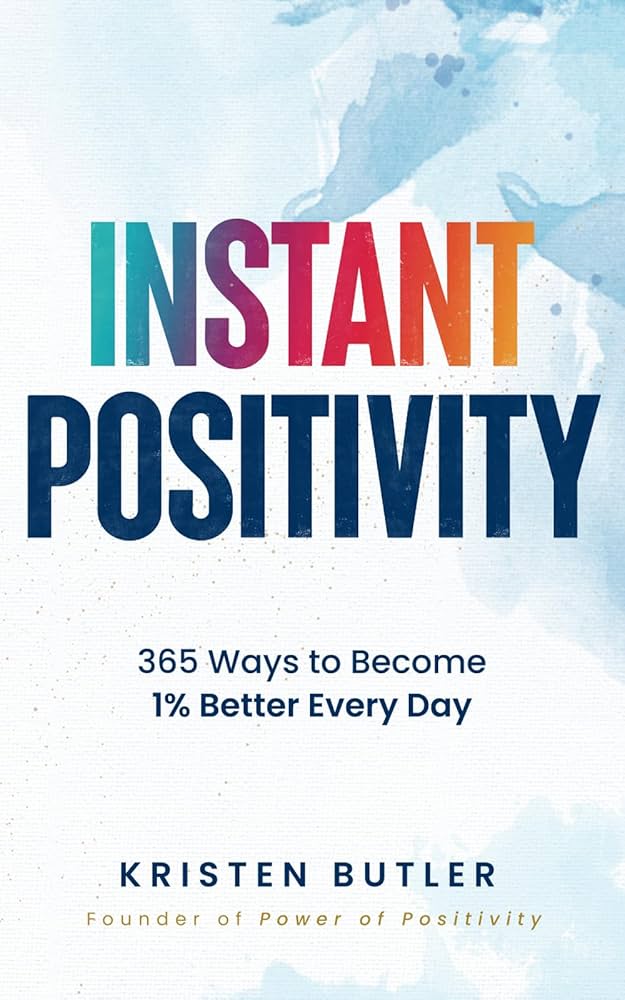
Most self-help books today come with a lot of weight. They give you complex theories, rigid routines, and a silent pressure to fix your life fast. Some almost make you feel guilty for not being happy enough already. This book does the opposite. It doesn’t push. It doesn’t preach. It simply sits beside you and says, “Life is hard sometimes. Let’s just make this moment a little easier.”
It reads less like a guidebook and more like a conversation you might have with a friend over tea—someone who listens first, understands your exhaustion, and then gently offers a small, practical suggestion.
The human behind the book: Kristen Butler
Years ago, Kristen was struggling deeply—with panic attacks so intense she could barely get out of bed, with depression, and with serious financial stress. Life was not working. And she didn’t suddenly “think positive” and escape it all. What she did instead was much smaller—and far more realistic.
To really understand why this book feels so real, you need to know a bit about its author, Kristen Butler. She is not someone who discovered positivity from a perfect life. Her journey started at the opposite end.

She began experimenting with tiny shifts in her thinking. Not big affirmations. Not grand life plans. Just one thought at a time. She realised something powerful: she couldn’t control everything happening to her, but she could control the very next thought she chose. That insight eventually led her to create the Power of Positivity community in 2009, which today reaches millions across the world.
When you read this book, you can feel that lived experience. She writes like someone who knows how overwhelming mornings can feel, how heavy thoughts can get at night, and how fragile motivation can be. She doesn’t promise to change your life. She promises to help you get through it—one moment at a time.
The big idea (made very small)
The core idea of Instant Positivity is wonderfully simple: you don’t need to change your whole life to feel better—you only need to change this moment.
Most of us run on mental autopilot. Someone says something rude, traffic is bad, a meeting goes poorly, or we make a small mistake—and instantly the mind spirals. Why does this always happen to me? I’m terrible at this. Today is ruined. It all happens so fast that we think it’s automatic and unavoidable.
Kristen asks us to slow down just enough to notice that tiny gap between what happens and how we react. And in that gap, she suggests asking one gentle question:
“What’s one small thought that would help me right now?”
Not a perfect thought. Not a dramatic positive one. Just a slightly better one.
For example:
- Instead of “I can’t handle this,” try “I can handle the next ten minutes.”
- Instead of “Everything is going wrong,” try “This part is hard, but not everything.”
- Instead of “I failed,” try “I learned something uncomfortable today.”
These sound simple—and they are. But repeated over time, they change how you experience your days.
As psychologist William James famously said, “The greatest weapon against stress is our ability to choose one thought over another.” This book is essentially a practical manual for doing exactly that.
Why this actually works (science agrees)
What makes Instant Positivity more than feel-good advice is that psychology backs it up. Research in positive psychology shows that even small positive emotions—calm, hope, relief—change how the brain works. When we feel slightly better, our thinking becomes clearer and more flexible. We problem-solve better. We recover from stress faster.
Psychologist Barbara Fredrickson explains that positive emotions “broaden” our thinking. When we’re stuck in negativity, the mind narrows. When we feel even a little uplifted, options reappear.
Kristen’s approach fits perfectly with this. Positivity here is not denial. It’s not pretending life is perfect. It’s simply helping your brain function better in difficult moments.
Ancient wisdom, everyday language
What’s beautiful is that this idea isn’t new. Ancient traditions have been saying the same thing for centuries—just in different words.
The Bhagavad Gita reminds us that the mind can be our greatest friend or our greatest enemy. The Stoic philosopher Epictetus said, “It’s not what happens to you, but how you react to it that matters.” Buddhism begins with right understanding—not right circumstances.
Even mythology reflects this truth. Arjuna doesn’t escape the battlefield; his understanding shifts. Perseus doesn’t defeat Medusa with brute strength; he changes how he looks at her. Perspective becomes power.
Kristen brings this ancient wisdom into daily life—into emails, traffic jams, tough conversations, and sleepless nights.
Why it feels safe and real
One of the strongest qualities of Instant Positivity is what it doesn’t do. It doesn’t force cheerfulness. It doesn’t tell you to smile through pain. It avoids what many now call “toxic positivity.”
Instead, it follows a healthy emotional flow: feel first, reframe second. You’re allowed to feel tired, angry, disappointed, or sad. Those emotions aren’t wrong. The book simply helps you not get stuck in them.
As psychologist Carl Rogers said, “The curious paradox is that when I accept myself just as I am, then I can change.” This book quietly lives by that principle.
A gentle rhythm for everyday life
In a world full of noise, notifications, and comparison, Instant Positivity offers a calm rhythm:
Something goes wrong.
Pause.
Breathe.
Choose a kinder thought.
That’s it.
You don’t finish the book feeling “fixed.” You finish it feeling more aware. You catch negative spirals sooner. You respond instead of react more often. You feel lighter—not because life became easy, but because you became gentler with yourself.
And in today’s heavy world, that lightness isn’t trivial. It’s essential.
This book isn’t about permanent happiness. It’s about instant relief, practiced daily, slowly building a life that feels more manageable, more humane, and more kind.
And sometimes, that’s exactly what we need.
_ Dr Mukesh jain
 School Of Happiness by Mukesh Jain