What Happens to Identity When Work Stops Defining Worth
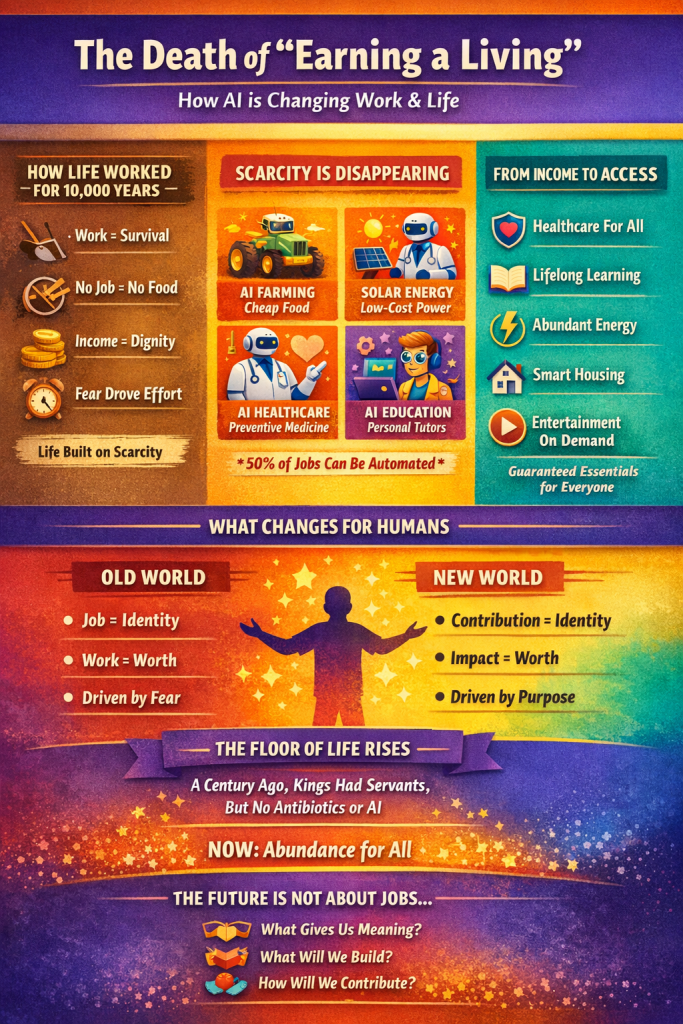
For most of human history, work served a brutally simple function: it kept us alive. Long before careers, passion projects, or personal brands existed, human effort was tied directly to survival. If you worked, you ate. If you did not, you suffered. Over time, this biological reality hardened into a psychological and social rule: your right to exist had to be earned. Entire civilizations were built on this assumption, and human identity slowly fused with labor.
This survival-based logic shaped not only economies but minds. Work became the primary answer to life’s deepest questions: Who am I? What am I worth? Why do I matter? In a world of scarcity, these answers were practical. Contribute, and you belong. Produce, and you are valued. Fail to do so, and you are expendable. This is why the phrase “earning a living” was never metaphorical—it was existential.
However, the conditions that made this logic necessary are now changing. Rapid advances in artificial intelligence, robotics, energy systems, and biotechnology are steadily removing the very scarcities that once justified lifelong struggle. Food production is becoming automated and hyper-efficient. Renewable energy, managed by intelligent grids, is pushing energy costs toward historic lows. Healthcare is shifting from episodic, human-limited treatment to continuous, AI-assisted prevention. Education is moving away from standardized classrooms toward personalized, lifelong learning systems.
These shifts are not speculative. The World Economic Forum estimates that more than half of all work tasks globally are already automatable with existing technologies. At the same time, research in precision agriculture shows yield increases of 20–50% with dramatically lower water and resource use. In healthcare, AI systems now match or outperform average clinicians in diagnostics such as radiology and dermatology. In education, meta-analyses of personalized tutoring—long before AI—show learning gains of up to two standard deviations, a difference so large it can change life trajectories.
What is emerging, quietly but unmistakably, is a world in which survival no longer requires full human employment. This is not simply an economic disruption; it is a psychological rupture. When work is no longer essential for survival, the old identity structure collapses. Young people sense this intuitively, which is why anxiety about the future often feels vague, existential, and difficult to articulate. The fear is not just about losing jobs—it is about losing meaning.
Psychologists have long understood that human motivation changes dramatically once basic needs are met. As Abraham Maslow argued, when physiological and safety needs are secured, attention naturally shifts toward belonging, esteem, and self-actualization. More recent research reinforces this idea. Edward Deci and Richard Ryan, through Self-Determination Theory, show that human well-being depends less on external rewards and more on autonomy, competence, and purpose. In other words, when survival pressure eases, people do not stop striving—they start seeking meaning.
Yet our institutions, narratives, and education systems are still organized around an outdated survival model. Young people are often told to “find stable jobs” in a world where stability itself is dissolving. They are trained to optimize productivity in systems that no longer need maximum human labor. This mismatch creates a quiet crisis: high levels of anxiety, burnout, and identity confusion even among those who appear outwardly successful.
The common policy response to automation has been the idea of Universal Basic Income—providing cash to replace lost wages. While well-intentioned, this approach still assumes that money is the central gateway to dignity. In an abundance-driven future, a more structural solution is emerging: Universal Basic Services. Instead of giving people money to navigate broken markets, societies directly guarantee access to essentials such as healthcare, education, energy, housing, and digital infrastructure.
From a psychological perspective, this shift is profound. When access to life’s fundamentals is assured, fear recedes from the center of decision-making. The nervous system relaxes. Cognitive bandwidth expands. People gain the freedom to ask not “How do I survive?” but “What do I contribute?” This is not about removing effort; it is about removing coercion. Contribution becomes a choice rather than a condition for existence.
History offers a revealing parallel. In 1930, John Maynard Keynes predicted that technological progress would eventually reduce the need for long working hours, forcing humanity to confront its “permanent problem”—how to live wisely and well once economic necessity fades. Nearly a century later, that prediction is arriving not as leisure utopia, but as a meaning challenge.
The future of work, then, is less about jobs and more about identity. Status will increasingly derive from contribution rather than occupation, from impact rather than income. Creative work, caregiving, community-building, learning, and problem-solving will matter more than formal employment. We already see early signals of this shift in open-source communities, creator economies, volunteer networks, and mission-driven startups—spaces where people contribute not because they must, but because they care.
For youth, this transition is both unsettling and historic. It removes the old scripts but opens a rare opportunity. No previous generation has had to define purpose at scale without survival as the organizing force. That task now falls to those growing up in the shadow of abundance. The central question is no longer how to earn a living, but how to live meaningfully when existence itself is no longer conditional.
The death of “earning a living” does not signal the end of ambition, effort, or excellence. It marks the end of fear as the primary driver of human life. What replaces it—purpose, creativity, wisdom, or distraction—will shape the next chapter of civilization. And that chapter will be written less by machines, and more by the choices humans make when they are finally free to choose.
 School Of Happiness by Mukesh Jain