
In 2013, a short six-minute film quietly appeared on the internet. It did not feature glamorous models, dramatic lighting, or fancy makeup. Instead, it showed a room, a curtain, a sketch artist, and a few ordinary women. Yet within days, this simple video exploded across the world. More than 15 million people watched it in the first week, and soon it was everywhere—from television news to social media timelines.
This was Dove Real Beauty Sketches, one of the most emotional and talked-about pieces of advertising ever created. And at its heart was one powerful message:
You are more beautiful than you think.
To understand why this message resonated so deeply, we need to look at where the idea came from—and how the team behind it turned a quiet insight into a global conversation.
Why Dove Created the Experiment
Dove had been running its famous Campaign for Real Beauty since 2005. It was born from a worrying discovery:
🔹 Only 2% of women described themselves as beautiful in 2004.
🔹 By 2013, the number had risen slightly—but it was still only 4%.
🔹 Most women—54%—saw themselves as their own harshest critic when it came to appearance.
These numbers shocked the Dove team. How could almost every woman in the world believe she didn’t look good enough?
The campaign’s creative director, Anselmo Ramos from Ogilvy & Mather (Brazil), says they wanted to find a way to convince the remaining 96% that they were beautiful too. They explored many ideas, but one stood out—an unscripted, real experiment involving a forensic sketch artist.
But even then, the team wasn’t sure it would work.
They wondered:
Would women really describe themselves negatively?
Would strangers see them differently?
Would the contrast be strong enough to make a point?
No one knew. But they decided to try.
Bringing the Experiment to Life
To make it authentic, Dove and Ogilvy searched for someone with incredible skill—someone trained to sketch faces based purely on voice descriptions. After extensive research, they selected Gil Zamora, an FBI-trained forensic artist who had drawn more than 3,000 police sketches. His warm personality was perfect for the project.
The director, John X. Carey, and the team found women from different backgrounds through normal casting. No one knew what the experiment was about.
They were simply told to arrive at a loft in San Francisco.
When the women entered the studio, they met each other briefly and chatted casually. They didn’t know that this small interaction would later become the basis for the second sketch.
Inside the Sketch Room
One by one, the women were called behind a curtain.
Gil couldn’t see them at all.
He only heard their voices.
He asked simple questions:
“What shape is your face?”
“Tell me about your chin.”
“How would you describe your eyes?”
The women were told to use neutral, factual language. But something else happened. They spoke critically, focusing on every detail they saw as wrong:
● “I have a rounder face.”
● “My jaw protrudes.”
● “My forehead is big.”
Gil sketched exactly what he heard.
The next day, strangers who had met these women briefly in the loft came in. Gil asked them to describe the same women—also without seeing them.
Their language was surprisingly different:
● “She had kind eyes.”
● “She looked friendly.”
● “Her smile lit up her face.”
Gil created a second sketch based on each stranger’s description.
When the two drawings were placed side by side, the differences were dramatic.
The self-described portraits looked older, more tired, and far less flattering.
The stranger-described portraits looked softer, more accurate, and noticeably more beautiful.
Women gasped. Some cried. One whispered, “Is that really me?”
Another admitted, “I think I’m more beautiful than I thought.”
The film ended with the now-famous line:
“You are more beautiful than you think.”
The World Reacts
When Dove released the film on April 14, 2013, they hoped it would reach women—but they did not expect the explosion that followed.
Within four days, the short version had 7.5 million views.
Both versions crossed 15 million views within one week.
By June 2013, it had reached 163 million global views, won the Titanium Grand Prix at Cannes, and generated 4.6 billion media impressions.
It became one of the most shared videos in internet history.
Mainstream media responded quickly:
⭐ The Daily Telegraph called it Dove’s “most thought-provoking film.”
⭐ Huffington Post said its message was simple but powerful.
⭐ Adweek praised it as emotional and original.
But there was criticism too:
● A Forbes writer said the film focused too much on appearance, even while trying to challenge beauty standards.
● Some critics noted that many women chosen were young and thin.
● A Bloomberg writer argued the experiment wasn’t scientifically perfect.
Yet, despite the criticism, the emotional truth of the film touched millions.
The message felt real because the reactions were real.
Advertising experts said the campaign worked because it tapped into a deep human truth:
Many women underestimate themselves—not just in beauty, but in life.
5. Why It Still Matters Today
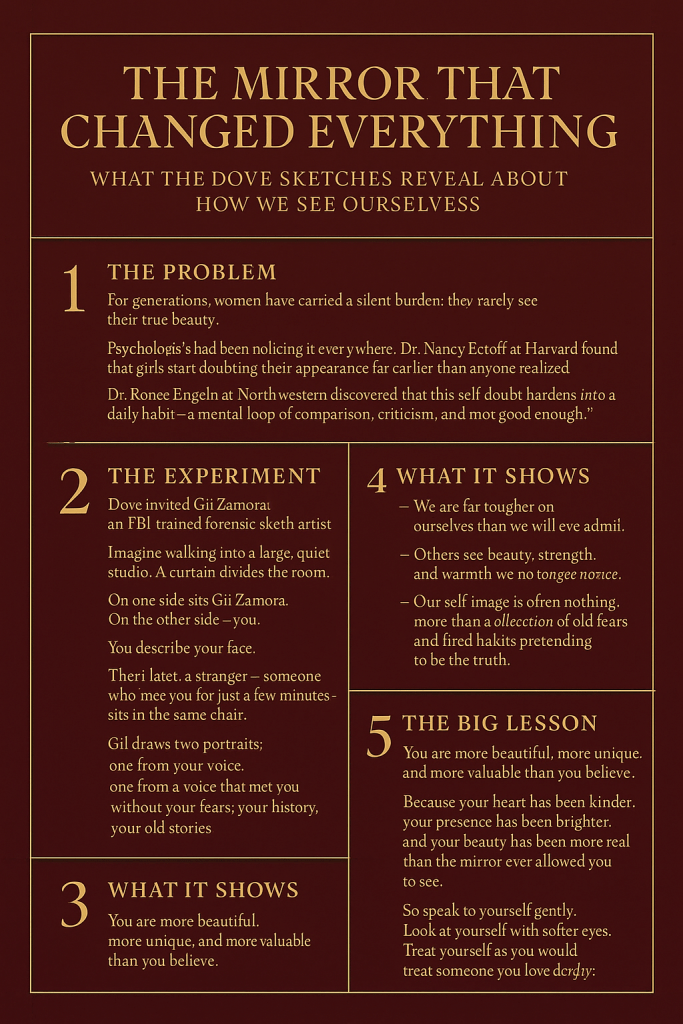
The Dove Sketches didn’t simply show two portraits—they revealed how differently we see ourselves compared to how others see us.
Researchers have long known this:
● People tend to magnify their flaws.
● Women especially carry years of self-criticism shaped by culture and comparison.
● Others often see kindness, warmth, and beauty that we overlook.
The sketches turned these insights into a mirror—a mirror that showed women their real reflection for the first time.
And sometimes, that is all a person needs to start healing their relationship with themselves.
Final Message
You are far more beautiful, more worthy, and more extraordinary than your inner critic believes.
Be gentle with yourself.
Let yourself see what others already see in you.
 School Of Happiness by Mukesh Jain