
I love to start my happiness workshops with the story of ‘Four Minutes a Mile’ and over time it has become the inspiration mantra for myself!
The Myth of the Unbreakable Barrier
For centuries, the idea of running a mile in under four minutes sat firmly in the realm of the impossible. It wasn’t just a challenge—it was presumed to be a scientific certainty that it couldn’t be done. Experts in sports physiology believed the human body simply wasn’t engineered for such speed over that distance. Doctors claimed that attempting it could be dangerous, warning that a runner’s heart might explode, lungs might collapse, or muscles would tear apart under the sheer intensity.
Coaches whispered the same thing to their athletes. “Don’t even try. It’s humanly impossible.”
Runners themselves began to believe it. The 4-minute mile became a mythical, unbreakable barrier, a number that loomed over the track like an iron gate that no one could force open.
And for decades, no one did.
Then came a young medical student from Oxford, a man with no professional coaching, no fancy training facilities, and no belief in the so-called ‘limits’ of the human body.
His name was Roger Bannister.
And on May 6, 1954, he changed everything.
The Race That Changed History
It was a cold, windy day at the Iffley Road track in Oxford, England. Not exactly the kind of conditions ideal for making history.

Bannister had been balancing his medical studies with his training—running between hospital shifts, squeezing workouts into whatever time he could spare. He had no fancy coaching program, no scientific training regimen. What he had was strategy, relentless determination, and an unshakable belief that the limit everyone feared was nothing more than a myth. That day, 3,000 spectators gathered around the track, their breath fogging in the chilly air, unaware that they were about to witness one of the greatest sporting moments of all time.
Bannister had carefully planned the race. He wasn’t going to break the record alone. He had enlisted two friends—Chris Brasher and Chris Chataway—to act as pacemakers, controlling the speed of the race so that he could conserve his energy and unleash a final, decisive sprint.
Lap One: The Clock Starts
The gun went off, and Brasher took the lead, setting a strong but controlled pace. Bannister followed closely, knowing that every second mattered. The crowd watched in silent anticipation, fully aware of the weight of the moment.
Lap Two: Doubt Creeps In
As they rounded the second lap, the wind picked up. Bannister fought against it, his legs pounding the track, but he knew he was losing valuable time.
In his mind, a voice whispered the doubts of generations—What if they were right? What if this was impossible?
But he silenced the thought. He had trained for this. He had imagined this moment a thousand times in his head.
Lap Three: The Pain Kicks In
Chris Chataway took over pacing duties now, ensuring that Bannister remained on track. The crowd could feel the tension, their collective heartbeat rising with the rhythm of the race.
Bannister knew this was the moment where most runners cracked. Their legs gave out, their breathing became erratic, and their minds surrendered to fatigue.
But he had one final weapon: a devastating finishing kick.
Lap Four: The Impossible Becomes Possible
As the bell rang for the final lap, Chataway moved aside. This was it.
Bannister dug deep, summoning every ounce of strength left in his body. The pain was unbearable, but he refused to let up. He stretched his stride, threw his arms forward, and let his entire body explode into motion.
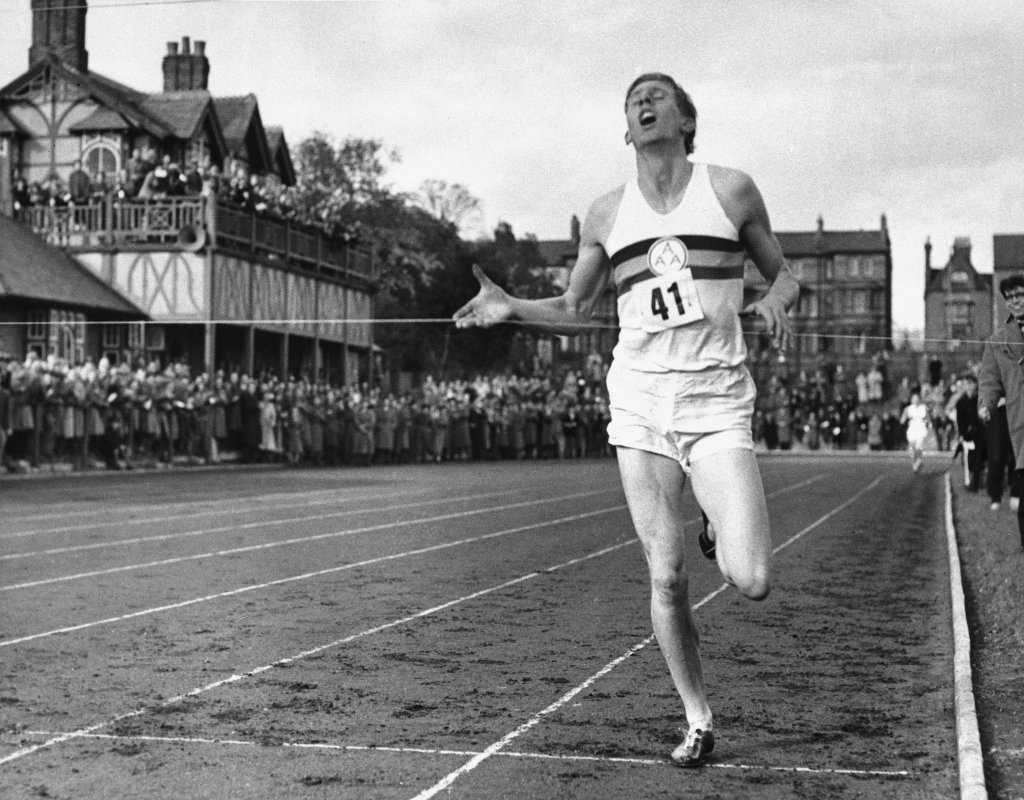
The finish line was approaching.
The crowd roared, voices merging into a blur of sound. The clock ticked closer and closer to four minutes.
With a final burst of speed, Bannister threw himself across the finish line, then collapsed onto the track, utterly spent.
For a moment, no one knew the official time. The crowd held its breath. The announcer’s voice crackled through the loudspeakers:
“Three minutes…”
A pause.
“…fifty-nine point four seconds!”
The stadium erupted.
History had just been made.
The Moment the World Changed
Bannister had done more than run fast. He had destroyed a psychological barrier.

And what happened next was even more astonishing.
Just 46 days later, another runner—John Landy of Australia—broke Bannister’s record with a time of 3:57.9.
Within a few years, dozens of runners had broken the so-called “impossible” barrier. Today, even high school athletes run sub-4-minute miles. The record now stands at an astonishing 3:43.13, set by Hicham El Guerrouj in 1999.
The human body didn’t suddenly evolve.
The track surface didn’t suddenly improve.
What changed?
The belief that it could be done.
The 4-Minute Mile Phenomenon: A Blueprint for Breaking Your Own Limits
Bannister’s story isn’t just about running—it’s about what happens when you refuse to accept limits. This principle applies to every field:
- Business: Before Jeff Bezos built Amazon, people said online shopping wouldn’t replace retail stores.
- Science: Before the Wright brothers, people said humans couldn’t fly.
- Technology: Before Elon Musk, people said electric cars could never replace gasoline vehicles.
These are all “4-minute mile moments.”
When one person proves something is possible, the entire world follows.
The lesson? Your limits aren’t real. They’re just waiting for you to challenge them.
Bannister proved something groundbreaking: the limits we believe in aren’t real—they are just mental roadblocks we accept as fact. And once those mental barriers collapse, everything changes.
This story isn’t just about running. It’s about breaking through in business, science, technology, personal growth, and even in the way we think about the future. The “4-minute mile phenomenon” is a blueprint for how to defy limits in any field!
Why the 4-Minute Mile Myth Was So Powerful
The reason no one broke the 4-minute mile before Bannister wasn’t because no one was fast enough—it was because no one believed it was possible.
This is what psychologists call “learned helplessness”—a concept developed by Martin Seligman, the father of positive psychology. When we are conditioned to believe that something isn’t possible, we stop trying. So, the real question isn’t whether limits exist—it’s whether you believe them.
The Science of Breaking Barriers
What happened after Roger Bannister broke the 4-minute mile is what psychologists call the “Expectation Effect.”
- When one person proves something is possible, others quickly follow because their mindset shifts from “It’s impossible” to “If they can do it, so can I.”
- Studies in sports psychology show that belief in ability is one of the strongest predictors of peak performance.
- Neuroscientists have found that when people believe something is possible, their brain rewires itself to find ways to make it happen.
Bannister didn’t just train his body—he trained his mind. Unlike other runners who focused on endurance alone, he used interval training, visualization, and deliberate recovery—techniques now commonly used in high-performance training.
The lesson? When you train your mind, you change the game.
The 4-Minute Mile Blueprint for Your Own Life
What if the biggest limits in your life are just illusions? What if the barriers you think are unbreakable are only waiting for someone—you—to challenge them?
Roger Bannister’s story isn’t just about running—it’s about breaking mental barriers. And this principle isn’t limited to athletics. It applies to everything—from business and creativity to personal growth and success.
The greatest barriers in life are not physical—they exist in the mind. The real challenge isn’t whether something is possible, but whether you believe it is. Every major breakthrough, every impossible feat, begins with someone daring to challenge the limits imposed by others. If you want to achieve something extraordinary—whether it’s launching a business, achieving financial freedom, writing a book, transforming your health, or mastering a skill—you must break the mental barriers holding you back.
The first step is to identify your own 4-minute mile. What is that one thing you deeply desire but secretly believe is out of reach? It’s easy to dismiss dreams as unrealistic, but the truth is, the only thing standing between you and success is the belief that it’s possible. Question the doubts, challenge the excuses, and rewrite the narratives that have held you back. The world has always been changed by those who refused to accept limitations. Someone else’s disbelief should never define your potential.
But no one breaks barriers alone. The people you surround yourself with can either lift you higher or reinforce the doubts that keep you stuck. If you want to go beyond what seems possible, you need to seek out those who think bigger, push further, and reject mediocrity. Spend time with people who challenge you, inspire you, and encourage you to break free from limitations. The energy around you will either fuel your ambition or drain it. Choose wisely.
Breaking barriers isn’t just about working harder—it’s about working smarter. Those who achieve the extraordinary don’t simply put in more effort; they approach challenges differently. They train strategically, focus on the essentials, visualize success before it happens, and learn to recover as effectively as they push forward. Success isn’t about doing more; it’s about doing what actually moves the needle. Small, intentional improvements—compounded over time—create exponential results. When you shift from mindless effort to purposeful action, progress becomes inevitable.
And here’s the most important truth: you will never feel ready. The perfect moment to begin will never come. Every great achiever took the leap before they had it all figured out. They stepped into the unknown, learned along the way, and built momentum as they moved forward. Waiting for confidence is a mistake—confidence is built through action. The key is to start before you’re ready, to embrace uncertainty, and to trust that you will adapt as you go.
Roger Bannister’s story isn’t just about running—it’s about proving the impossible wrong. It’s about breaking through the limits that exist only in the mind and showing the world what is truly possible. And now, it’s your turn. What is the barrier you need to break? The dream you’ve been hesitating to pursue? The bold step you’ve been waiting to take? You are more capable, more powerful, and closer to success than you realize. The moment you decide to break through your mental limitations, the world will open up in ways you never imagined.
So stop waiting. Stop doubting. Take the first step. Run toward your own impossible goal—and break your own 4-minute mile.
———————————————————–
about the Author
Dr Mukesh Jain is a Gold Medallist engineer in Electronics and Telecommunication Engineering from MANIT Bhopal. He obtained his MBA from the Indian Institute of Management Ahmedabad. He obtained his Master of Public Administration from the Kennedy School of Government, Harvard University along with Edward Mason Fellowship. He had the unique distinction of receiving three distinguished awards at Harvard University: The Mason Fellow award and The Lucius N. Littauer Fellow award for exemplary academic achievement, public service & potential for future leadership. He was also awarded The Raymond & Josephine Vernon award for academic distinction & significant contribution to Mason Fellowship Program. Mukesh Jain received his PhD in Strategic Management from IIT Delhi.
Mukesh Jain joined the Indian Police Service in 1989, Madhya Pradesh cadre. As an IPS officer, he held many challenging assignments including the Superintendent of Police, Raisen and Mandsaur Districts, and Inspector General of Police, Criminal Investigation Department and Additional DGP Cybercrime, Transport Commissioner Madhya Pradesh and Special DG Police.

Dr. Mukesh Jain has authored many books on Public Policy and Positive Psychology. His book, ‘Excellence in Government, is a recommended reading for many public policy courses. His book- “A Happier You: Strategies to achieve peak joy in work and life using science of Happiness”, received book of the year award in 2022. After this, two more books, first, A ‘Masterclass in the Science of Happiness’ and the other, ‘Seeds of Happiness’, have also been received very well. His book, ‘Policing in the Age of Artificial Intelligence and Metaverse’ has received an extraordinary reception from the police officers. He is a visiting faculty to many business schools and reputed training institutes. He is an expert trainer of “Lateral Thinking”, and “The Science of happiness” and has conducted more than 300 workshops on these subjects.

 School Of Happiness by Mukesh Jain