Mukesh Jain


Haruki Murakami, is a prolific and internationally acclaimed author. His unique literary style blends elements of Japanese and Western literature, creating a narrative universe that transcends cultural boundaries. Murakami’s works often feature protagonists who embark on personal journeys of self-discovery, grappling with existential questions, the complexities of love, and the mysteries of the human mind. Murakami’s writing is characterized by its dreamlike quality, where the boundaries between reality and fantasy blur. His narratives are replete with references to music, literature, and pop culture, creating a rich tapestry that invites readers to reflect on the connections between the mundane and the extraordinary.
In “Colorless Tsukuru Tazaki and His Years of Pilgrimage,” Murakami weaves a tale that delves into the complexities of identity, the impact of loss, and the search for happiness. This novel, like much of Murakami’s work, combines the ordinary with the extraordinary, offering readers a nuanced exploration of the human experience. The novel follows the protagonist, Tsukuru Tazaki, a man who, despite his name meaning ‘colorless’ in Japanese, is an ordinary person with an extraordinary story. In his college years, Tsukuru was part of a close-knit group of friends, each named after a color—red, blue, black, and white—except him. However, abruptly and without explanation, his friends severed ties with him, leaving Tsukuru emotionally adrift. The narrative unfolds as Tsukuru embarks on a pilgrimage of self-discovery, seeking answers to the mysteries of his past and the reasons behind his friends’ actions. Through a series of encounters and revelations, Tsukuru confronts the ghosts of his past, ultimately seeking a sense of closure and understanding that has eluded him for years.


Happiness, for Murakami, is intricately linked to introspection and self-discovery. His characters often embark on internal journeys, confronting their fears and unraveling the layers of their identities to find a deeper understanding of themselves. Murakami emphasizes the importance of human connections in the pursuit of happiness. The relationships his characters form, whether romantic or platonic, play a crucial role in shaping their emotional landscapes and contributing to a sense of fulfillment. Happiness, in Murakami’s world, is not always predictable or easily defined. It emerges from embracing the unpredictable nature of life, acknowledging the impermanence of moments, and finding solace in the ebb and flow of emotions.
Music holds a special place in Murakami’s novels, acting as a powerful force that transcends language and connects characters on a profound level. The joy derived from music becomes a metaphor for the transcendent and transformative nature of happiness.
“Colorless Tsukuru Tazaki and His Years of Pilgrimage” is a testament to Haruki Murakami’s ability to blend the ordinary with the extraordinary, creating a narrative that resonates with readers on a deep emotional level. While not a direct exploration of happiness and joy, the novel intricately weaves these themes into the fabric of its storytelling. Haruki Murakami’s unique perspective on happiness invites readers to contemplate the subtle, nuanced moments that contribute to the tapestry of a fulfilling and meaningful life.

Some quotations from the book on happiness and related themes
“But that’s the way it is, and what’s coming will come, and we’ll just have to meet it when it does.”
“It’s just that, right at this moment, happiness is in short supply.”
“Hurt is a sort of debris that comes scattered through the air, and if you breathe it in, you feel poisoned.”
“No matter how deep the night, it always turns to day, eventually.”
“You can’t change the past. But the present and the future, those you can change.”
“We all have our time machines. Some take us back, they’re called memories. Some take us forward, they’re called dreams.”
“As long as you’re alive, somewhere in the world you have a role to play. But the only way you’ll find it is to love others and let yourself be loved in return.”
“It was as if he were playing a piece of music that he knew well, all the way through, and yet he couldn’t quite remember the next part.”
“Sometimes fate is like a small sandstorm that keeps changing directions. You change direction but the sandstorm chases you. You turn again, but the storm adjusts.”
“In the end, the world isn’t just a single person’s story.”
“He could think of no greater punishment than to have been born himself.”
“Each mistake and each failure is but another step on the path to times of glory.”
“Pain is inevitable. Suffering is optional.”
“It’s hard when you can’t muster the strength to want things, Tsukuru.”
“What you have experienced – no power on earth can take from you.”
“You can’t find the right answer if you ask the wrong questions.”
“Death is not the opposite of life but an innate part of it.”
“Time heals nothing. Wounds fester and ooze.”
“All he did was survive. That’s all he was ever capable of.”
“People die all the time. Life is a lot more fragile than we think.”
“People can change. In a way, you could say that’s what life is really all about.”
“One heart is not connected to another through harmony alone. They are, instead, linked deeply through their wounds.”
“It’s a hard thing, having to live knowing that the person you love isn’t in the same world you are.”
“Even chance meetings are the result of karma.”
“The truth sometimes reminds me of a city buried in sand. As time passes, the sand piles up even thicker, and occasionally it’s blown away and what’s below is revealed.”
“The world isn’t just going to be a stage someday. It’s a stage now. And we’re the players.”
“We’re not robots, Tsukuru. We don’t always function in the most logical way.”
“I have nothing to offer anyone except my own confusion.”
“Closing your eyes isn’t going to change anything. Nothing’s going to disappear just because you can’t see what’s going on.”
“You can hide memories, but you can’t erase the history that produced them.”
“You might be able to erase the markings, but the memories will never disappear.”
“But that doesn’t mean I’m going to stop thinking. I’ll think until my skull collapses.”
“Don’t let appearances fool you. There’s always only one reality.”
“People have their own reasons for doing things. And even if you ask them, they may not be able to explain.”
“It’s strange. The people you’re most fond of, who mean the most to you – they’re the ones who can make you feel the lowest.”
“What happens when you hurt people? They begin to love you less.”
“Silence, I discover, is something you can actually hear.”
“Life is a lot more fragile than we think.”
“As soon as you know the meaning of something, it loses its meaning.”
“You shouldn’t judge other people based on your own preconceptions.”
“Time can heal many wounds, but it’s not a cure-all.”
“Sometimes you have to go through the darkness to get to the light.”
“Things outside you are projections of what’s inside you, and what’s inside you is a projection of what’s outside.”
“Maybe working on the little things as dutifully and honestly as we can is how we stay sane when the world is falling apart.”
“You can’t go back to how things were. How you thought they were. All you really have is… now.”
“Is it possible, in the final analysis, for one human being to achieve perfect understanding of another?”
“It’s not so much that we’re afraid of change or so in love with the old ways, but it’s that place in between that we fear.”
“One heart is not connected to another through harmony alone. They are, instead, linked deeply through their wounds.”
“But maybe happiness isn’t in the choosing. Maybe it’s in the fiction, in the pretending: that wherever we have ended up is where we intended to be all along.”
“It’s like Tolstoy said. Happiness is an allegory, unhappiness a story.”


Dr Mukesh Jain is a Gold Medallist engineer in Electronics and Telecommunication Engineering from MANIT Bhopal. He obtained his MBA from the Indian Institute of Management Ahmedabad. He obtained his Master of Public Administration from the Kennedy School of Government, Harvard University along with Edward Mason Fellowship. He had the unique distinction of receiving three distinguished awards at Harvard University: The Mason Fellow award and The Lucius N. Littauer Fellow award for exemplary academic achievement, public service & potential for future leadership. He was also awarded The Raymond & Josephine Vernon award for academic distinction & significant contribution to Mason Fellowship Program. Mukesh Jain received his PhD in Strategic Management from IIT Delhi.
Mukesh Jain joined the Indian Police Service in 1989, Madhya Pradesh cadre. As an IPS officer, he held many challenging assignments including the Superintendent of Police, Raisen and Mandsaur Districts, and Inspector General of Police, Criminal Investigation Department and Additional DGP Cybercrime, Transport Commissioner Madhya Pradesh and Special DG Police.
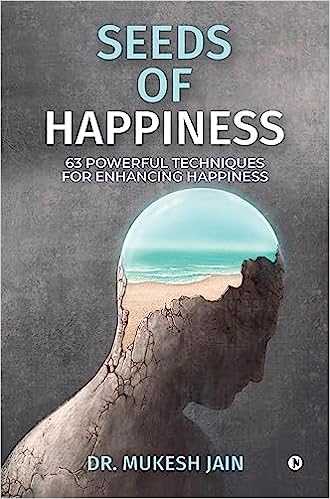
Dr. Mukesh Jain has authored many books on Public Policy and Positive Psychology. His book, ‘Excellence in Government, is a recommended reading for many public policy courses. His book- “A Happier You: Strategies to achieve peak joy in work and life using science of Happiness”, received book of the year award in 2022. After this, two more books, first, A ‘Masterclass in the Science of Happiness’ and the other, ‘Seeds of Happiness’, have also been received very well. He is a visiting faculty to many business schools and reputed training institutes. He is an expert trainer of “Lateral Thinking”, and “The Science of happiness” and has conducted more than 300 workshops on these subjects.
 School Of Happiness by Mukesh Jain