Mukesh Jain

It is interesting that the word for “happy” in most languages came from the word for “lucky.” This suggests an interesting trend—perhaps our ancestors believed that happiness was largely a by-product of luck?
The word “happiness” has its roots in Old Norse and Old English, where it initially took on the form of “hap,” meaning luck or chance. The word underwent a linguistic evolution over time, gradually transforming into “happiness” as we recognize it today. The etymology of the word reflects a fascinating journey through different languages and cultural contexts, shedding light on the human understanding of well-being and contentment.
The earliest known usage of the word “happiness” dates back to the 16th century. During this period, the term was employed to describe a state of well-being and good fortune. It was closely linked to the concept of luck or fortune, emphasizing the role of chance in determining one’s state of happiness. This connection to luck persisted in the language, influencing the perception of happiness as something dependent on external circumstances.
In its original form, the word “hap” was derived from the Old Norse word “happ,” which denoted good luck or chance. The Old Norse language, spoken by the Vikings and other Germanic tribes, played a crucial role in shaping the linguistic landscape of the region. The Norse influence on English vocabulary, including words related to happiness, is a testament to the cultural interplay in medieval Europe.
As the word “happiness” continued to evolve, it underwent semantic shifts, gradually distancing itself from a mere reliance on luck. During the Enlightenment in the 17th and 18th centuries, philosophical thinkers explored the concept of happiness in more depth. Influential figures such as John Locke, Jean-Jacques Rousseau, and others contributed to the intellectual discourse surrounding human well-being.
The emergence of the term “happiness” in the context of philosophical discussions marked a departure from its earlier associations with luck. Enlightenment philosophers sought to define and understand happiness as an inherent aspect of the human experience, influenced by individual actions, virtue, and societal conditions. This shift in perspective laid the groundwork for a more nuanced understanding of happiness as a complex interplay between internal and external factors.
Throughout the centuries, various languages have developed their own terms for happiness, each carrying its unique cultural and linguistic nuances. For instance, the German word “Glück” and the French word “bonheur” capture different facets of the emotional spectrum associated with happiness. Exploring the linguistic diversity of happiness-related terms reveals the intricate ways in which different cultures articulate and conceptualize this universal human experience.
In contemporary usage, “happiness” has become a broad and encompassing term, encompassing emotional well-being, life satisfaction, and a sense of fulfillment. Scholars and researchers from diverse fields, including psychology, sociology, and philosophy, continue to investigate the nature of happiness, contributing to our evolving understanding of this complex phenomenon.
It also points to a possible difference of general opinion between earlier generations and our own 20th and 21st-century generations: that happiness was not a vital factor in a good life, but essentially a bonus that some lucky individuals got to experience.
Here’s what author Darrin McMahon writes about the origins and root words of the word “happiness:”
“It is a striking fact that in every Indo-European language, without exception, going all the way back to ancient Greek, the word for happiness is a cognate with the word for luck. Hap is the Old Norse and Old English root of happiness, and it just means luck or chance, as did the Old French heur, giving us bonheur, good fortune or happiness. German gives us the word Gluck, which to this day means both happiness and chance.”
Today, human beings tend to think of happiness as a natural right. But they haven’t always felt this way. For the ancient Greeks, happiness meant virtue. For the Romans, it implied prosperity and divine favor. For Christians, happiness was synonymous with God. Throughout history, happiness has been equated regularly with the highest human calling, the most perfect human state. Yet it’s only within the past two hundred years that human beings have begun to think of happiness as not just an earthly possibility but also as an earthly entitlement, even an obligation. In this sweeping new book, historian Darrin M. McMahon argues that our modern belief in happiness is the product of a dramatic revolution in human expectations carried out since the eighteenth century.
I think it is probably fair to assume that most Americans today consider happiness not only something that would be nice to have, but something that we really ought to have—and, moreover, something that’s within our power to bring about, if only we set our minds to it. We can be happy, we tell ourselves, teeth gritted. We should be happy. We will be happy.
That is a modern article of faith. But it is also a relatively recent idea in the West which dates from the 17th and 18th centuries, a time that ushered in a dramatic shift in what human beings could legitimately hope to expect in and from their lives. People prior to the late 17th century thought happiness was a matter of luck or virtue or divine favor. Today we think of happiness as a right and a skill that can be developed. This has been liberating, in some respects, because it asks us to strive to improve our lots in life, individually and collectively. But there have been downsides as well. It seems that when we want to be happy all of the time, we can forget that the pursuit of happiness can entail struggle, sacrifice, even pain.
Roots of happiness
Language reveals ancient definitions of happiness. It is a striking fact that in every Indo-European language, without exception, going all the way back to ancient Greek, the word for happiness is a cognate with the word for luck. Hap is the Old Norse and Old English root of happiness, and it just means luck or chance, as did the Old French heur, giving us bonheur, good fortune or happiness. German gives us the word Gluck, which to this day means both happiness and chance.
What does this linguistic pattern suggest? For a good many ancient peoples—and for many others long after that—happiness was not something you could control. It was in the hands of the gods, dictated by Fate or Fortune, controlled by the stars, not something that you or I could really count upon or make for ourselves. Happiness, literally, was what happened to us, and that was ultimately out of our hands. As the monk in Chaucer’s Canterbury Tales declares:
And thus does Fortune’s wheel turn treacherously And out of happiness bring men to sorrow.
In other words, the wheel of fortune controls our happenstance, and hence our happiness.
There were, of course, other ways of thinking about happiness. Those who have studied Greek or Roman philosophy will know that happiness—what the Greeks called, in one of several words, eudaimonia—was the goal of all Classical philosophy, beginning with Socrates and Plato, then taken up even more centrally by Aristotle, then featured prominently in all the major “schools” of Classical thought, including that of the Epicureans, Stoics, and so forth. In their view, happiness could be earned, a perspective that anticipates our modern one.
But there is a crucial difference between their ideas of happiness and ours. For most of these Classical philosophers, happiness is never simply a function of good feeling—of what puts a smile on our face—but rather of living good lives, lives that will almost certainly include a good deal of pain. The most dramatic illustration of this is the Roman statesman and philosopher Cicero’s claim that the happy man will be happy even on the torture wrack.
That sounds ludicrous to us today—and perhaps it is—but it very nicely captures the way the ancients thought of happiness, not as an emotional state but as an outcome of moral comportment. “Happiness is a life lived according to virtue,” Aristotle famously says. It is measured in lifetimes, not moments. And it has far more to do with how we order ourselves and our lives as a whole than anything that might happen individually to any one of us.
Given these presuppositions, the ancients tended to agree that very few would ever succeed in being happy, because happiness takes an incredible amount of work, discipline and devotion, and most people, in the end, are simply not up to the task. The happy are what Aristotle calls “happy few.” They are, if you like, the ethical elite. This is not a democratic conception of happiness.
After the Greek and Roman traditions, we have Jewish and Christian ideas about happiness. In the prevailing Christian understanding, happiness can occur in one of three circumstances. It can be found in the past in a lost Golden Age, in the Garden of Eden when Adam and Eve were perfectly content. It can be revealed in the future—the millennium when Christ will return and the Kingdom of God will genuinely be at hand. Or we can find happiness in heaven, when the saints shall know the “perfect felicity,” as Thomas Aquinas puts it, the pure bliss of union with God. Strictly speaking, this is the happiness of death.
And so in the dominant Christian worldview, happiness is not something we can obtain in this life. It is not our natural state. On the contrary, it is an exalted condition, reserved for the elect in a time outside of time, at the end of history. This is the opposite of today’s egalitarian, feel-good-now conception of happiness.
Happiness revolution
Enter the 17th and 18th centuries, when a revolution in human expectations overthrew these old ideas of happiness. It is in this time that the French Encyclopédie, the Bible of the European Enlightenment, declares in its article on happiness that everyone has a right to be happy. It is in this time that Thomas Jefferson declares the pursuit of happiness to be a self-evident truth, while his colleague George Mason, in the Virginia Declaration of Rights, speaks of pursuing and obtaining happiness as a natural endowment and right. And it is in this time that the French revolutionary leader St. Just can stand up during the height of the Jacobin revolution in France in 1794 and declare: “Happiness is a new idea in Europe.” In many ways it was.
When the English philosopher and revolutionary John Locke declared at the end of the 17th century that the “business of man is to be happy,” he meant that we shouldn’t assume that suffering is our natural lot, and that we shouldn’t have to apologize for our pleasures here on earth. On the contrary, we should work to increase them. It wasn’t a sin to enjoy our bodies, his contemporaries began to argue. It wasn’t gluttony and greed to work to improve our standards of living. It wasn’t a sign of luxury and depravity to pursue pleasures of the flesh, and whatever other kind as well. Pleasure was good. Pain was bad. We should maximize the one and minimize the other, yielding the greatest happiness for the greatest number.
This was a liberating perspective. Starting in Locke’s time, men and women in the West dared to think of happiness as something more than a divine gift, less fortuitous than fortune, less exalted than a millenarian dream. For the first time in human history, comparatively large numbers of people were exposed to the novel prospect that they might not have to suffer as an unfailing law of the universe, that they could—and should—expect happiness in the form of good feeling, and pleasure as a right of existence. This is a prospect that has gradually spread from the originally rather narrow universe of white men to include women, people of color, children—indeed, humanity as a whole.
This new orientation towards happiness was, as I say, liberating in many respects. I would argue that it continues to lie behind some of our most noble humanitarian sentiments—the belief that suffering is inherently wrong, and that all people, in all places, should have the opportunity, the right, to be happy.
Unnatural happiness
But there is a dark side to this vision of happiness as well, one that may help explain why so many of us are snapping up books about happiness and coming to happiness conferences, searching for an emotion that we worry is absent from our lives.
For all its pleasures and benefits, this new perspective on happiness as a given right, tends to imagine happiness not as something won through moral cultivation, carried out over the course of a well-lived life, but as something “out there” that could be pursued, caught, and consumed. Happiness has increasingly been thought to be more about getting little infusions of pleasure, about feeling good rather than being good, less about living the well-lived life than about experiencing the well-felt moment.
Don’t get me wrong, there is nothing bad about feeling good. But I would suggest that something of value may have been lost or forgotten in our transition to modern ideas of happiness. We can’t feel good all the time; nor, I think, should we want to. Nor should we assume that happiness can be had (maybe a better word?) without a certain degree of effort, and possibly even sacrifice and pain. These are things that the older traditions knew—in the West and the East alike—and that we have forgotten.
Today, science is rediscovering the validity of ancient perspectives on happiness—that there are important connections between hope and happiness, for example, or between gratitude and forgiving and happiness, altruism and happiness. Science is often painted as being opposed to matters of the spirit, but new discoveries by researchers like Michael McCullough, Robert Emmons, and many others remind us how important non-materialistic, spiritual cultivation is to our happiness and well-being. It is all the more important to revive and cultivate this older wisdom today, given that so many of us assume that we ought to be happy as a matter of course, that this is our natural state.
Indeed, if you think about it, this idea of happiness as a natural state creates a curious problem. What if I’m not happy? Does that mean that I’m unnatural? Am I ill, or bad, or deficient? Is there something wrong with me? Is there something wrong with the society in which I live? These are all symptoms of a condition that I call the unhappiness of not being happy, and it is a peculiarly modern condition.
To cure this condition, we might focus less on our own personal happiness and instead on the happiness of those around us, for relentless focus on one’s own happiness has the potential to be self-defeating. The 19th century philosopher John Stuart Mill once said, “Ask yourself whether you are happy, and you cease to be so.” Whether that is really true or not, I don’t know. But given that we live in a world that asks this question of us every day, it is a paradox worth pondering.
THE THREE DIMENSIONS OF HAPPINESS
Happiness can be defined as an enduring state of mind consisting not only of feelings of joy, contentment, and other positive emotions, but also of a sense that one’s life is meaningful and valued (Lyubomirsky, 2001).
Happiness energizes us and is a highly sought after state of being. But, what components make up happiness?
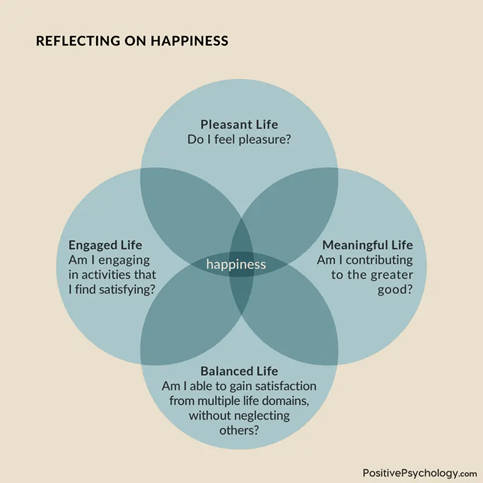
Martin Seligman (2002) argued that happiness has three dimensions that can be cultivated:
The regular experience of pleasantness (the pleasant life)
The frequent engagement in satisfying activities (the engaged life)
The experience of a sense of connectedness to a greater whole (the meaningful life)
Although each dimension is important, the happiest people tend to be those who pursue the full life— they infuse their life with pleasure, engagement, and meaning (Seligman et al., 2005).
Building on Seligman’s three dimensions of happiness, Sirgy and Wu (2009) added the balanced life dimension.
According to these authors, balance in life is another key factor contributing to happiness because the amount of satisfaction derived from a single life domain is limited. One needs to be involved in multiple domains to satisfy the broad spectrum of human needs. As a result, cultivating a sense of balance is crucial for juggling these life domains.

 School Of Happiness by Mukesh Jain